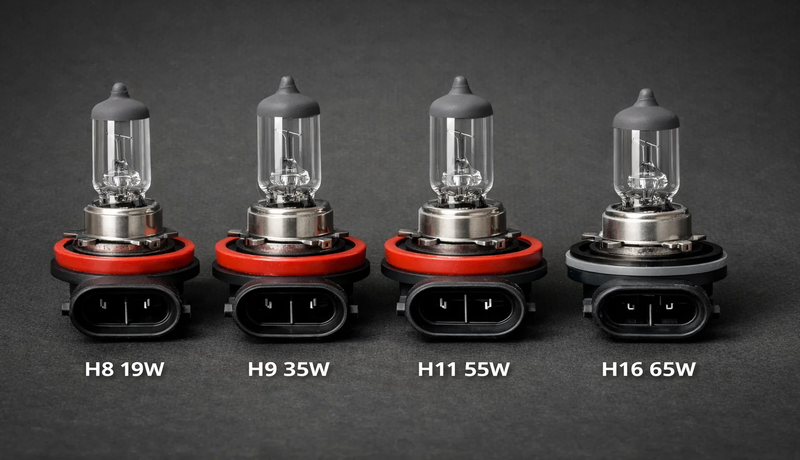
Wondering if H11, H8, H9, or H16 bulbs interchangable? Physically, the plugs look similar. But long-term safety, heat tolerance, and housing are completely changed because of their intended use.
In this article, we’ll go beyond the surface. You’ll learn why these bulbs aren’t always interchangeable, and also how to choose the right one without risking your vehicle’s headlights or fog lights.
Are H11, H8, H9, and H16 Bulbs Interchangeable?
H11, H8, H9, and H16 bulbs share a similar PGJ19 socket design. But they are not designed to be safely interchangeable. Installing the wrong bulb can lead to overheating, housing damage, and even wiring issues over time.
Most of the people think they are interchangeable due to:
- Similar plug shapes
- Same PGJ19 base family
- LED products marketed as “H11/H8/H9/H16”
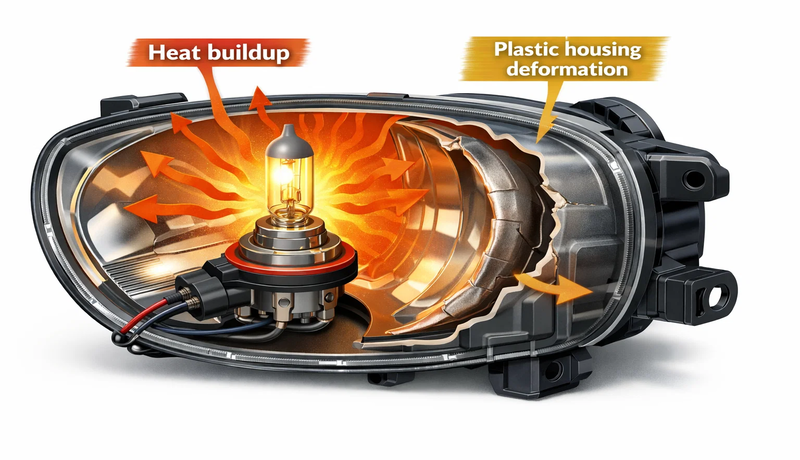
Even if the bulb fits physically, a higher wattage bulb cannot be installed in housings not designed for that. When installing it, heat can cause connector failure, plastic deformation, and reflector damage issues that usually appear gradually.
Why H11, H8, H9, and H16 Bulbs Look Similar but Are Not the Same
At first glance, H11, H8, H9, and H16 bulbs seem identical. Many car owners assume that a similar shape or connector means they can be swapped freely. However, appearances can be deceiving. Subtle design differences control heat, wattage limits, and housing compatibility.
1. The PGJ19 Base Family
The PGJ19 base family refers to the connector type, not the bulb itself. Manufacturers designed these similar connectors for efficiency, not interchangeability. Mostly H8, H9, H11, and H16 use the same plug design. However, each bulb is engineered for specific wattage limits, heat levels, and housing types.
These bulbs were never meant to be drop-in replacements for one another.
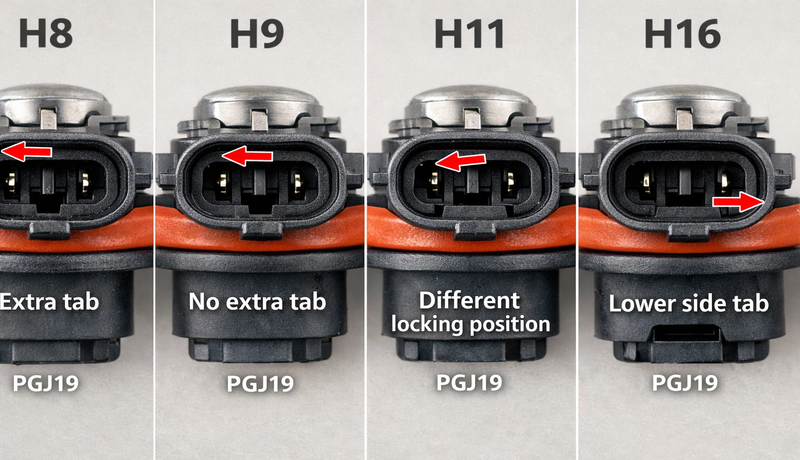
2. What the Tabs and Base Design Actually Control
The tabs on each bulb are critical safety features. They control:
Maximum allowed wattage:
The tabs stop bulbs that are too powerful from fitting in the housing. For example, an H9 bulb produces more heat than an H11 or H8 bulb. If the tabs allowed it to fit anyway, the excess wattage could cause the plastic housing or reflector to melt over time.
Heat entering the housing:
The base and tab design also allows the bulb to sit inside the headlight or fog light. Proper positioning ensures that heat is distributed safely and doesn’t directly contact sensitive parts.
Misaligned bulbs, even if they plug in, can direct excessive heat toward plastic housings or lenses. It causes deformation, discoloration, or premature failure of the reflector and surrounding components.
Compliance with OEM and safety regulations:
Automotive manufacturers design bulbs and housings to meet strict safety standards. They comply with regulations for maximum heat, beam pattern, and electrical load. Tabs and bulb bases enforce this by preventing incorrect combinations.
It ensures that the installed bulb matches the vehicle’s intended performance and safety parameters. Using a bulb with the wrong tab alignment can unintentionally violate these regulations and even reduce lighting effectiveness on the road.
H11 vs H8 vs H9 vs H16: What They Mean in Real Use
Comparison Table
| Bulb | H8 | H9 | H11 | H16 |
|---|---|---|---|---|
| Typical Application | Fog Lights | High Beam | Low Beam / Fog | Fog Light |
| Wattage | 35W | 65W | 55W | 19W |
| Lumens Output | ~800–1,000 lumens | ~2,100–2,300 lumens | ~1,300–1,500 lumens | ~500–700 lumens |
| Heat Output | Low | High | Medium | Low |
| Approx. Brightness | Moderate | High | Medium | Low |
| Lifespan (Hours) | 800–1,200 hours | 250–500 hours | 500–1,000 hours | 1,500–2,000 hours |
| Bulb Type | Halogen | Halogen | Halogen | Halogen(low wattage) |
Why H9 Is the Brightest — and Why That Creates Risk
H19 halogen headlight bulbs are the brightest bulbs in the H8/H11 family. They achieve higher brightness by operating at higher temperatures. It increases heat stress on the housing. The heat moves directly into the headlight housing.
H9 bulbs were never designed as an “upgrade” for H11 or H8. They are engineered specifically for high-beam use. They are best used for situations where short bursts of light are needed rather than continuously. High beams usually sit inside metal housings. Metal can tolerate high temperatures without deforming or degrading.
Low beams and fog lights are different. They often use plastic housings and stay on for long periods. When an H9 is installed in a housing designed for H11 or H8, the housing is exposed to heat levels it was never built to handle.
This does not usually cause immediate failure. Heat slowly weakens the plastic, the reflector coating, and the bulb socket. Over time, this can lead to warped housings, dull beam output, and permanent lighting damage.
Higher brightness always comes with higher heat stress. That tradeoff is the main reason H9s are risky outside their intended application.
Why H8 and H16 Are Intentionally Lower Powered
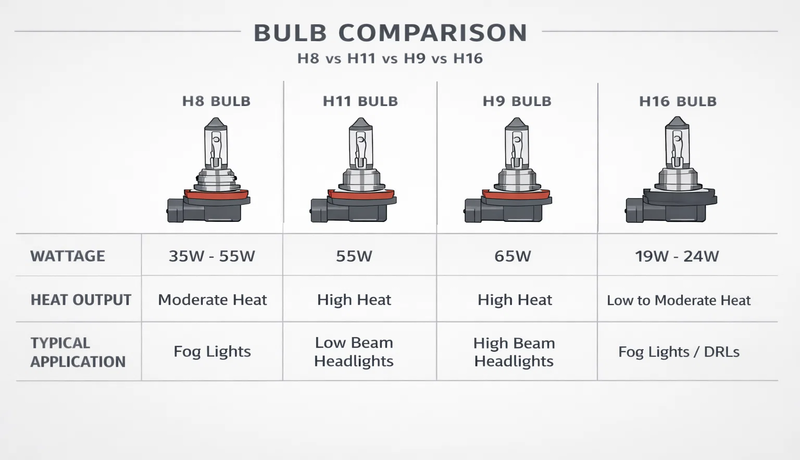
H8 and H16 bulbs are mainly used in fog lights. Fog lights are usually installed low on the bumper and use plastic housings. These lights can stay on for long periods, especially in rain, fog, or winter driving.
Because of this, heat control becomes more important than brightness.
Lower wattage is not a weakness in H8 and H16 bulbs. It is a design choice to prevent heat buildup inside the housing. Running a stronger bulb in these locations may seem like an upgrade, but it can slowly damage the fog light assembly.
That’s why H8 and H16 are designed to produce stable light with lower heat output. Inshort, brightness alone does not determine compatibility. The housing’s ability to handle heat is the real limit.
Key Takeaway: Heat Tolerance Matters More Than Brightness
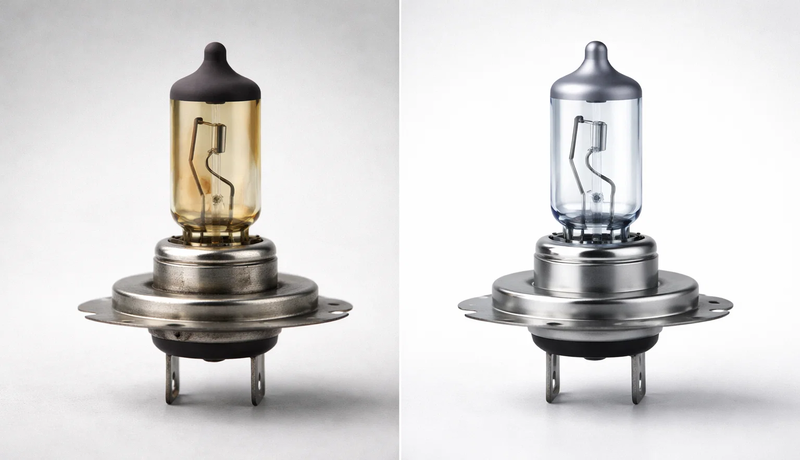
A brighter bulb does not automatically mean it is compatible with your vehicle. Safety and compatibility depend on how much heat the headlight or fog light housing can handle. If the housing is not designed for higher temperatures, even a physically fitting bulb can cause damage over time.
The biggest difference usually comes down to heat, which directly affects bulb lifespan. That’s why heat tolerance, not brightness, is the real limit when choosing between H8, H9, H11, and H16. Always read the owner’s manual before replacement. Never replace a bulb without checking compatibility.
What Happens When the Wrong Bulb Is Installed
Installing the wrong bulb usually does not cause instant failure. Most problems develop slowly and go unnoticed at first.
Short-term (days to weeks)
In the beginning, the extra heat affects the bulb socket and connector. The plastic around the connector starts to dry out or discolor. Electrical contact can also be weakened due to constant heat exposure. This leads to flickering or intermittent lighting.
Medium-term (weeks to months)
As heat continues, the housing itself begins to change shape. Plastic parts soften and lose their original alignment. The reflector surface can also degrade. Over time, the beam pattern becomes distorted. Light spreads unevenly instead of forming a clean cutoff. This reduces the light direction onto the road.
Long-term
Even though the bulb still works, visibility becomes worse. In some cases, wiring damage develops behind the housing. Most damage does not happen immediately, but it develops over time.
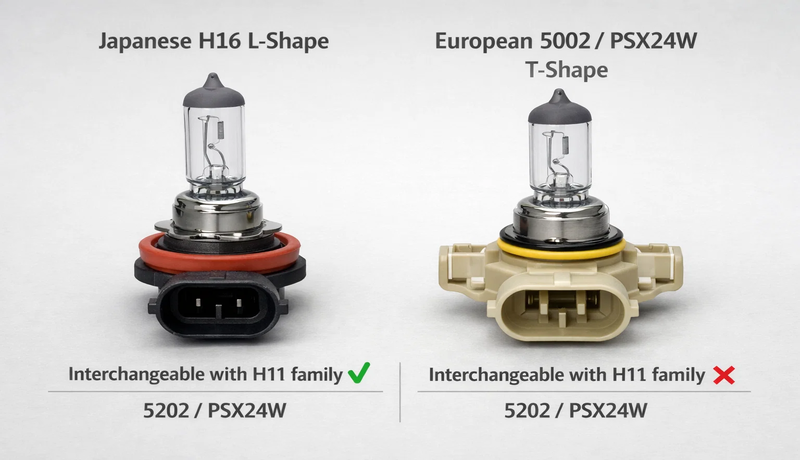
The H16 Name Trap: Two Completely Different Bulbs Sold as “H16”
The name H16 is one of the confusing terms in automotive lighting. Many buyers assume that all H16 bulbs are the same. But in reality, two completely different bulbs are sold under this name.
Japanese H16 (Low-Wattage Fog Bulb)
The Japanese-market H16 is part of the same physical family as H11, H8, and H9. It uses a similar connector shape. That’s why people believe it can replace an H11 bulb.
However, this H16 bulb is designed to run at very low power. It is intended only for fog lights that use plastic housings and long operating times.
European H16 / 5202 / PSX24W Bulb
The European version of H16 is completely different. It does not share the same base, locking tabs, or connector design. This bulb is also known as 5202 or PSX24W, and it is not part of the PGJ19 family at all. Despite sharing the same “H16” name, it cannot fit into H8, H9, or H11 sockets.
When Swapping Bulbs Works — and When It Doesn’t
Swapping bulbs is not just about whether they fit into the socket. A bulb can click into place and still be unsafe for long-term use.
1. Original Bulb Wattage
Every headlight or fog light housing is designed around a specific power level. If a replacement bulb produces more heat than the original, the housing can not handle it safely. Even small increases in wattage can raise internal temperatures significantly. That’s why upgrading halogen headlight bulbs based only on brightness often causes problems later.
2. Housing Material: Plastic vs Metal
Most fog lights and many low beams use plastic housings. Plastic cannot tolerate sustained high heat. High-beam housings are more likely to be metal. These can handle higher temperatures, which is why stronger bulbs like H9 are used there. Using a high-heat bulb in a plastic housing is one of the most common causes of damage.
3. Usage Pattern
The period the light stays on matters. Fog lights and low beams often run continuously. High beams are used briefly. Because of this difference, some bulbs are safe in one position but risky in another.
Common Swap Scenarios Explained
| Swap Scenario | Physical Fit | Safe Long-Term | Explanation |
|---|---|---|---|
| H11 → H9 | Yes | No | H9 produces much more heat than an H11 housing is designed to handle. |
| H8 → H11 | Yes | No | Fog light housings are plastic and cannot tolerate H11 heat levels. |
| H16 → H11 | Yes | No | H16 is low power and not designed for low-beam performance. |
| H11 LED → H8/H9/H16 | Yes | Yes | LED reduces heat inside the housing while providing stable brightness. |
That’s why physical fit alone should never guide bulb selection. Safety depends on heat control, housing design, and real-world usage.
Why H11 LED Is the Safest Universal Alternative
Halogen bulb swaps fail mainly because of heat. When wattage increases, more heat stays trapped inside the housing. Modern automotive lighting focuses on efficiency and safety. LED bulbs work differently. They use less electrical power to produce usable light.
Instead of pushing heat forward into the headlight or fog light housing, LED designs move heat backward. This heat is released through a rear heat sink or cooling system. Because of this structure, much less heat reaches the plastic housing. This is the key reason LED bulbs can be used safely across multiple applications.
From an engineering perspective, LED does not try to overpower the housing. It reduces the thermal load instead. That’s why a single H11 LED bulb can safely replace H8, H9, and H16 bulbs in many vehicles. LED headlight bulbs avoid the core issue that makes halogen swaps risky.
Which Bulb Should You Choose?
Choosing the right bulb depends on the use of your vehicle. There is no single option that fits every driver. Understanding your driving habits helps prevent damage and poor lighting results.
1. For Daily Drivers
If you mainly use your car for regular commuting, stability matters most. OEM halogen bulbs or LED equivalents are the safest choice. They provide consistent lighting without increasing heat inside the housing. This helps protect the headlight system over long-term use.
2. For Drivers Seeking Brighter Output
Many drivers want more visibility at night. However, increasing halogen headlight bulbs’ wattage is not the right solution. Higher-wattage halogen bulbs create excess heat. This can slowly damage housings, reflectors, and wiring. A better option is LED. It delivers brighter usable light while keeping heat under control.
3. For Distributors and Retailers
Car lighting inventory can become complex very quickly. Stocking multiple halogen types increases cost and confusion. Universal LED bulbs reduce the number of SKUs needed. Universal LED designs are built with adjustable bases or compatible locking positions. This allows one LED headlight bulb to fit multiple PGJ19 sockets safely.
Because LEDs generate less forward heat, they do not rely on housing-specific wattage limits.
This makes a single LED design usable across H8, H9, H11, and H16 applications. For distributors, this reduces stock complexity.
For car drivers, it lowers the risk of choosing the wrong bulb. They also lower return rates caused by compatibility mistakes. For professional sellers, LED provides a safer and more efficient solution.
Conclusion
H11, H8, H9, and H16 bulbs look similar, but they are not truly interchangeable. Swapping halogen bulbs without considering heat, wattage, and housing type can cause long-term damage.
LED bulbs provide a safer alternative by reducing heat, maintaining brightness, and working across multiple applications. Choosing the right bulb is about more than fit. It ensures safety, durability, and consistent lighting performance for your vehicle.
See How Our Lighting Solutions Work for You
Choosing the right bulb can make a big difference in safety and performance. CarLightVision universal LED solutions simplify upgrades for drivers and distributors alike. Explore our full range of lighting options or get in touch to discuss your needs.
Frequently Asked Questions
Q1: Is H16 the same as H11?
No. H16 comes in different versions. Always check the connector type before buying.
Q2: Why won’t H11 fit my H8 fog light?
H11 won’t fit because the tabs and flange are different. H8 and H11 both use PGJ19 bases, but the tabs are positioned differently (PGJ19-1 vs PGJ19-2). This prevents high-heat or wrong-size bulbs from fitting in a fog light housing. Always check the tab alignment before replacing bulbs.
Q3: Will a 65W H9 bulb melt my 19W H16 plastic housing?
Yes, it can. H9 bulbs generate much more heat than an H16 housing is designed to handle. Plastic fog light housings are rated for lower wattage; installing a 65W bulb can warp the housing over time. Stick to the recommended wattage or use LED to safely increase brightness.
Q4: Is H16 a 19W Japanese bulb or a 24W 5202 European bulb?
It can be either. Japanese H16 bulbs are low-wattage fog lights compatible with the H11 family. European 5202/PSX24W bulbs use a completely different base. Mistaking one for the other causes fitment issues and poor performance. Always verify the connector type and wattage before purchasing.