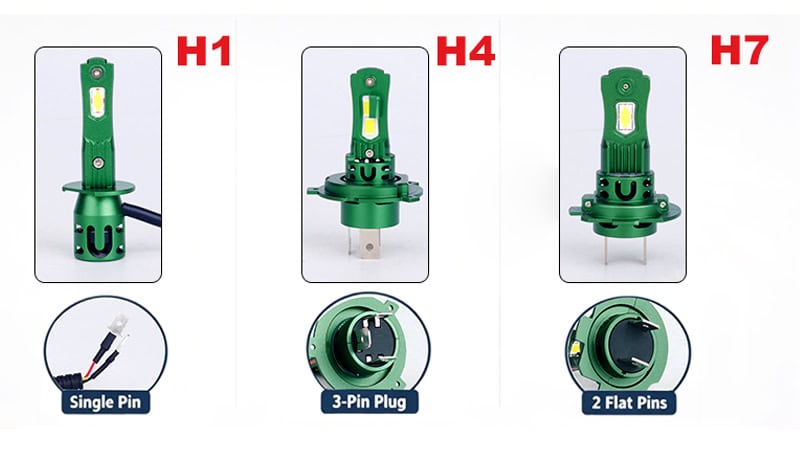
Short answer:
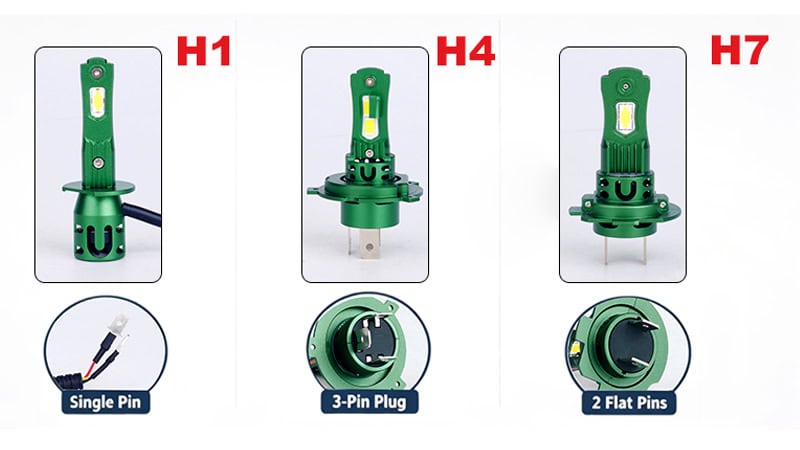
- H1 = Single-beam bulb (one filament), flat metal tab base. Used for high beams or fog lights in older cars.
- H4 = Dual-beam bulb (Low + high beam in one unit), three-prong bayonet base. Common in trucks, motorcycles, and Asian cars.
- H7 = Single-beam bulb (usually low beam), two-prong base with locating tab. The standard for modern European vehicles.
They are NOT interchangeable. Different base shapes mean they physically won’t fit each other’s sockets. The right one depends entirely on your vehicle’s headlight housing design.
Key Differences Explained
H1 Bulbs — The Single-Beam Classic
The H1 is the simplest of the three: a single filament with a flat metal tab base (designated P14.5s). It produces one beam pattern only — either low or high, never both. Because of its compact size and simple design, it’s been a workhorse for decades, especially in older vehicles and as dedicated high-beam or fog-light bulbs.
H1 bulbs are also common in motorcycles that use separate headlight units for low and high beam, rather than a single dual-beam assembly.
H4 Bulbs — The Dual-Beam All-Rounder
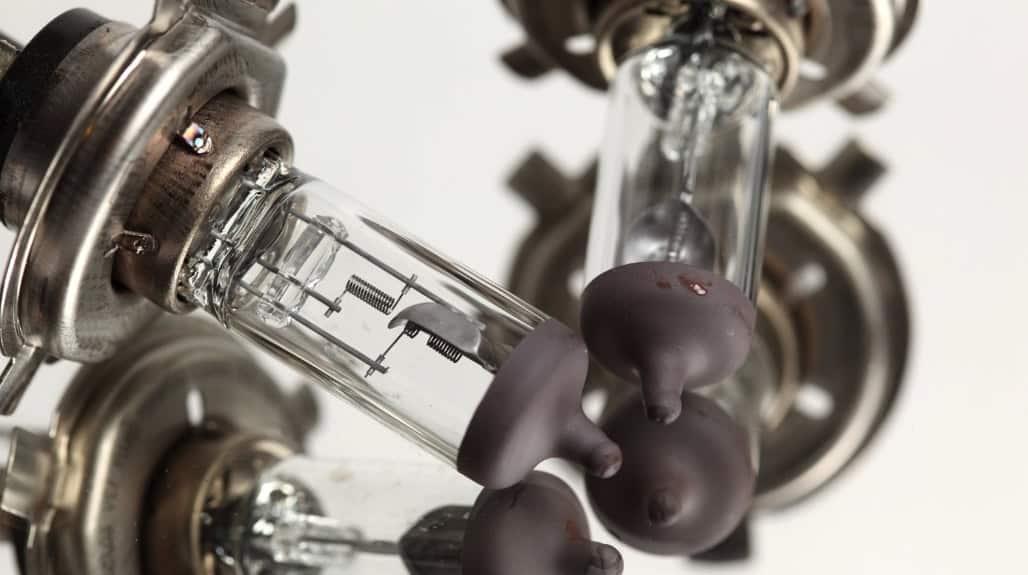
The H4 packs two filaments into one bulb (base: P43t). One filament sits lower for the low beam, the other higher for the high beam. A built-in shield creates the cutoff line for low beam. When you switch to high beam, both filaments light up. This is why H4 is sometimes called a “bi-xenon” or “dual-beam” bulb.
This dual-filament design means one H4 bulb does the job of two separate bulbs — which is why it’s popular in vehicles with compact headlight housings, like pickup trucks and motorcycles.
H7 Bulbs — The Precision Standard
The H7 (base: PX26d) is a single-filament bulb introduced later than H1, engineered specifically for low-beam precision. Its two-prong base with a locating tab ensures the bulb can only be inserted in one exact orientation — critical for a clean, sharp cutoff line that doesn’t blind oncoming traffic.
| Feature | H1 | H4 | H7 |
| Beam | Single | Dual(Low+High) | Single |
| Base | Flat tab(P14.5s) | 3-prong(P34t) | 2-prong+tab(PX26d) |
| Common in | Older cars,fog lights | Trucks,motorcycles | Modern European cars |
| Interchageable | No | No | No |
| Typical power | 55W | 55W/60W(Low/high) | 55W |
Vehicle Compatibility Table
Below is a quick reference for common vehicles. Always verify by checking your owner’s manual or the bulb itself, as trim levels and model years can vary.
| Brand | Model (Example) | Low beam | High beam | Fog Light |
| Volkswagen | Golf Mk7/Passat B8 | H7 | H7 | H11/H8 |
| Audi | A3 8P/A4 B8 | H7 | H7 | H11 |
| BMW | 3 Series E90/F30 | H7 | H7 | H8/H11 |
| Mercedes | C-Class W204/W205 | H7 | H7 | H11 |
| Volvo | XC60/S60 | H7 | H7 | H11 |
| Peugeot | 208/308/5008 | H7 | H7 | H11 |
| Ford | Focus Mk3 /Fiesta | H7 | H7 | H11 |
| Toyota | Hilux/ Fortuner | H4(dual) | H4(dual) | H11/H16 |
| Toyota | Corolla (pre-2018) | H4/H11 | H4/HB3 | H11 |
| Ford | Ranger T6/T7 | H4(dual) | H4(dual) | H11 |
| Nissan | Navara D40/ NP300 | H4(dual) | H4(dual) | H11 |
| Honda | Civic (2001-2005) | H4(dual) | H4(dual) | H11 |
| Honda | Civic (2006-2011) | H8/H11 | HB3 | H11 |
| BMW | 3 Series E36 (older) | H1 | H1 | H1/H3 |
| Mercedes | C-Class W202 (older) | H1 | H1 | H3 |
| Most Motorcycles | Universal single-headlight | H4(dual) | H4(dual) | NA |
How to Find Out Which Bulb Your Car Needs
- Check the owner’s manual — Look for “Bulb Specification” or “Lighting” in the index. It will list low beam, high beam, and fog light types separately.
- Read the old bulb — Remove the bulb from the back of the headlight (usually a quarter-twist). The type (“H1”, “H4”, “H7”) is printed or stamped on the metal base. This is the most reliable method.
- Use an online bulb finder — Enter your year, make, model, and trim. Note: some models have halogen and xenon options with different bulb types, so double-check.
- Take a photo of the socket — If you’re still unsure, take a clear photo of the empty bulb socket and message it to us — we’ll identify it for you.
Deep Dive: Why These Differences Matter
Why does H4 have dual beam?
The H4 was designed for vehicles with limited space behind the headlight. Instead of needing two separate bulbs (one for low, one for high) and two separate reflectors, the H4 combines both into a single bulb with a single reflector. The low-beam filament sits at the reflector’s focal point for a focused beam; the high-beam filament sits slightly forward, throwing light wider and farther. This saves space and cost — which is why it’s ubiquitous in trucks and motorcycles.
Why does H7 have the best cutoff line?
The H7’s PX26d base has a locating tab that forces the bulb into one exact rotational position. This means the filament (or LED chip) is always at the precise angle the headlight reflector was designed for. The result is a sharp, horizontal cutoff line — bright below the line, dark above — that illuminates the road without blinding oncoming drivers. H1’s flat-tab base is less precise, and H4’s dual-filament design inherently compromises both beam patterns slightly.
Why do European cars use H7?
European ECE regulations require a very specific beam pattern with a sharp asymmetric cutoff (the right side of the beam angles upward to illuminate road signs, while the left side stays flat to avoid blinding oncoming traffic in right-hand-drive countries). The H7’s precision-locating base makes it much easier for headlight designers to meet these
standards consistently. US DOT standards are more lenient, which is why many American-market cars use other bulb types like 9005/HB3 and 9006/HB4 instead.
Why do motorcycles use H4?
Motorcycle headlights are tiny. There’s simply no room for two separate bulbs and reflectors. The H4’s dual-beam design lets a single compact headlight unit provide both low and high beam. Additionally, many motorcycle headlight housings are designed around the H4’s round P43t base, which has been the motorcycle standard since the 1970s.
Why buying the wrong bulb is worse than you think
It’s not just that it won’t fit. Using an incorrect bulb type — even with an adapter — means the light source isn’t at the designed focal point of your reflector. The result is scattered light: some of it goes up into oncoming drivers’ eyes (glare), some goes sideways (wasted), and very little goes where you actually need it (the road ahead). You’ll actually see worse than with a correct halogen bulb, and you’ll fail any vehicle inspection that checks beam alignment.
Is H7 brighter than H1?
In halogen form, both H1 and H7 are typically rated at 55W, so they produce roughly the same raw lumens (~1000-1500 LM). The difference is beam pattern, not brightness. H7 spreads light wider with a better cutoff; H1 focuses it narrower. In LED form, brightness depends on the chip quality and driver, not the bulb type. A quality H7 LED and a quality H1 LED from the same manufacturer will have similar output.
LED Headlight Buyer’s Guide
When should you upgrade to LED?
Consider upgrading if:
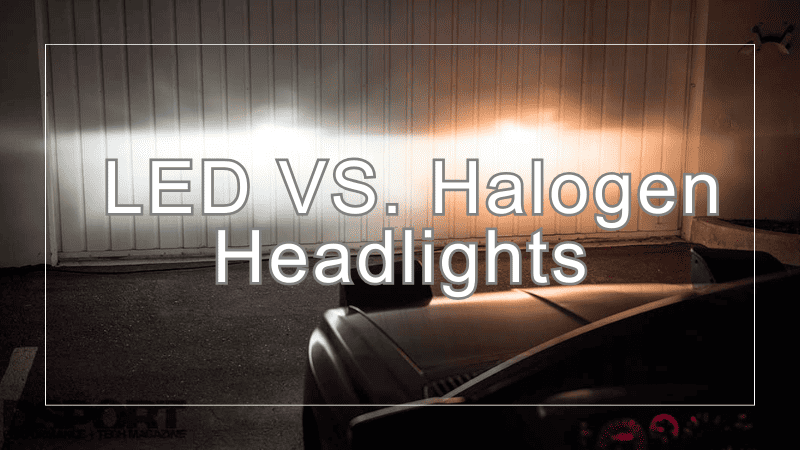
- Your halogen bulbs look yellow and dim compared to newer cars
- You frequently drive at night on unlit rural roads
- You’ve had to replace halogen bulbs more than once in 2 years
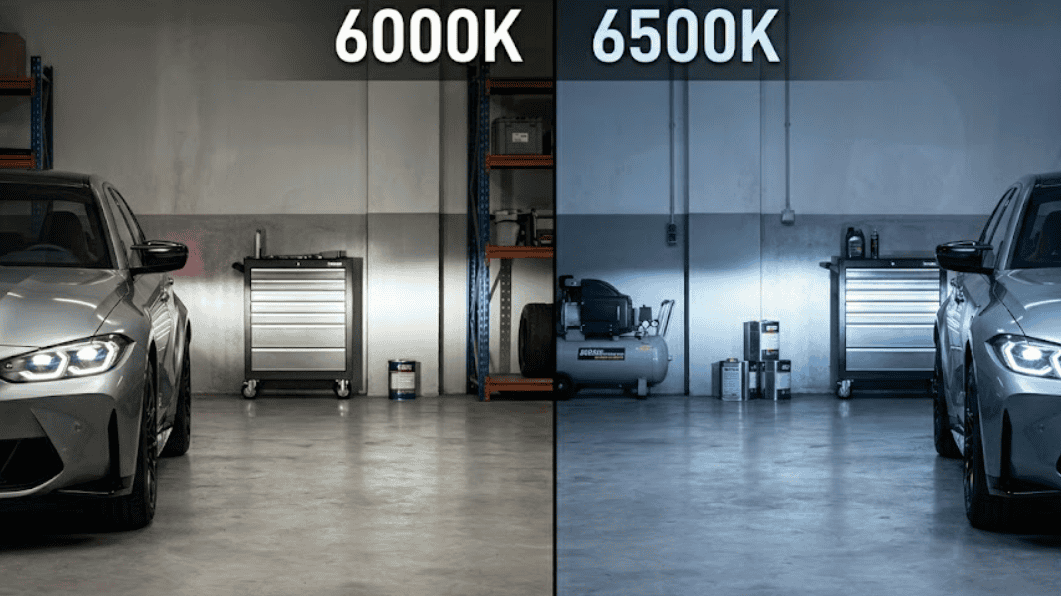
- You want better visibility in rain and fog (6000K white light cuts through better than yellow)
Can LED bulbs directly replace halogen?
Yes — if you buy the correct bulb type (H1/H4/H7/etc.), LED bulbs use the same socket and plug directly into your existing wiring. No modifications needed in most cases. However, there are two things to watch for:
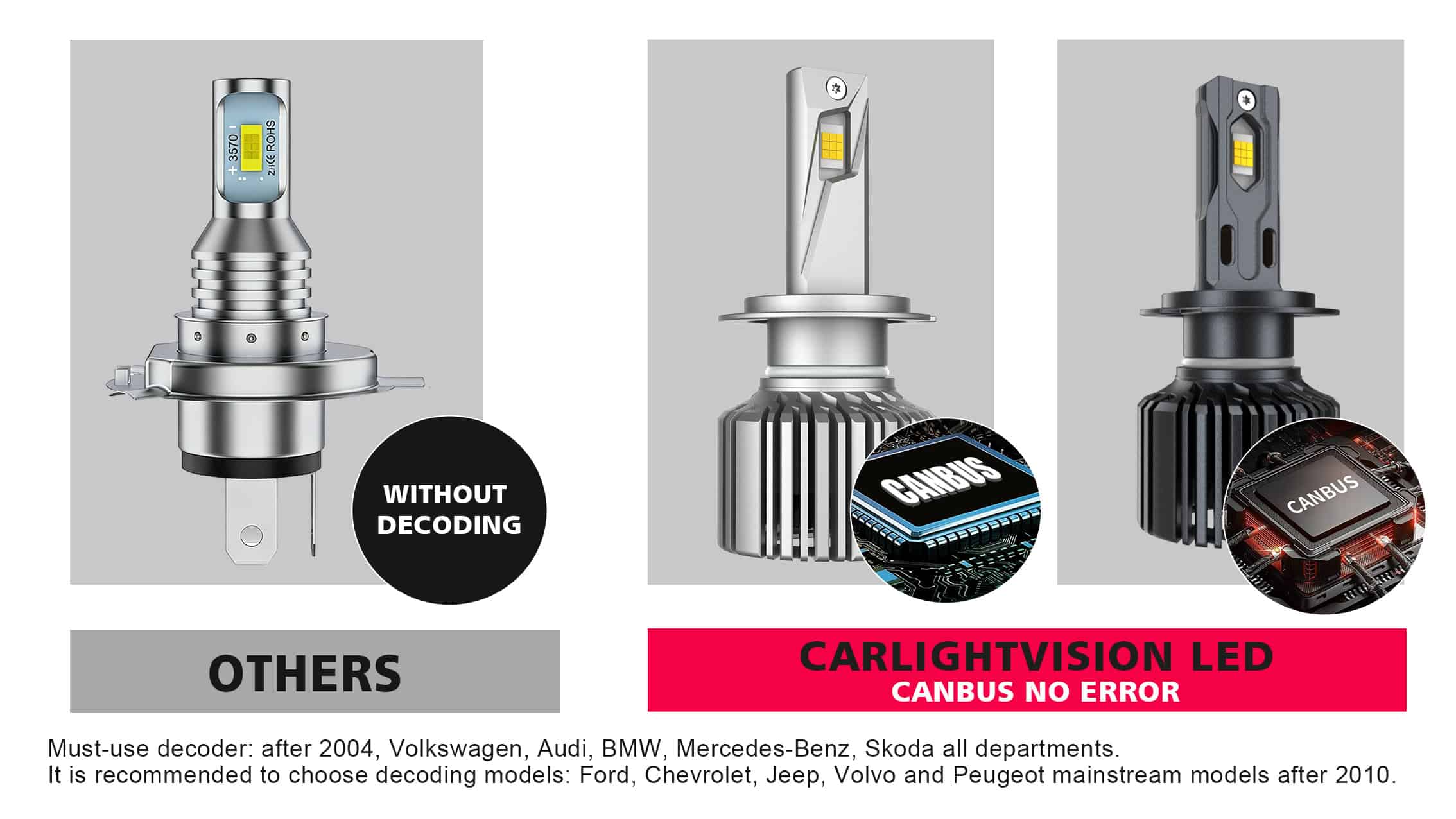
1. CANbus compatibility: Modern cars detect bulb resistance. LEDs draw less power, so the car may think the bulb is burnt out and throw an error code. Look for bulbs with built-in CANbus decoding. What is CANbus and do you need it? →
2. Dust cover fitment: LED bulbs with cooling fans are longer than halogen. Some cars have tight dust covers that won’t fit over the fan. Measure your available space before buying, or look for compact-design LEDs.
How to avoid false lumen claims
This is the #1 trap in the LED bulb market. Here’s what to look for:
- Ignore “per pair” numbers: Any listing that says “20,000 lumens” is almost certainly quoting both bulbs combined, or just making it up. Real per-bulb output for a quality LED is 1,500-2,500 LM.
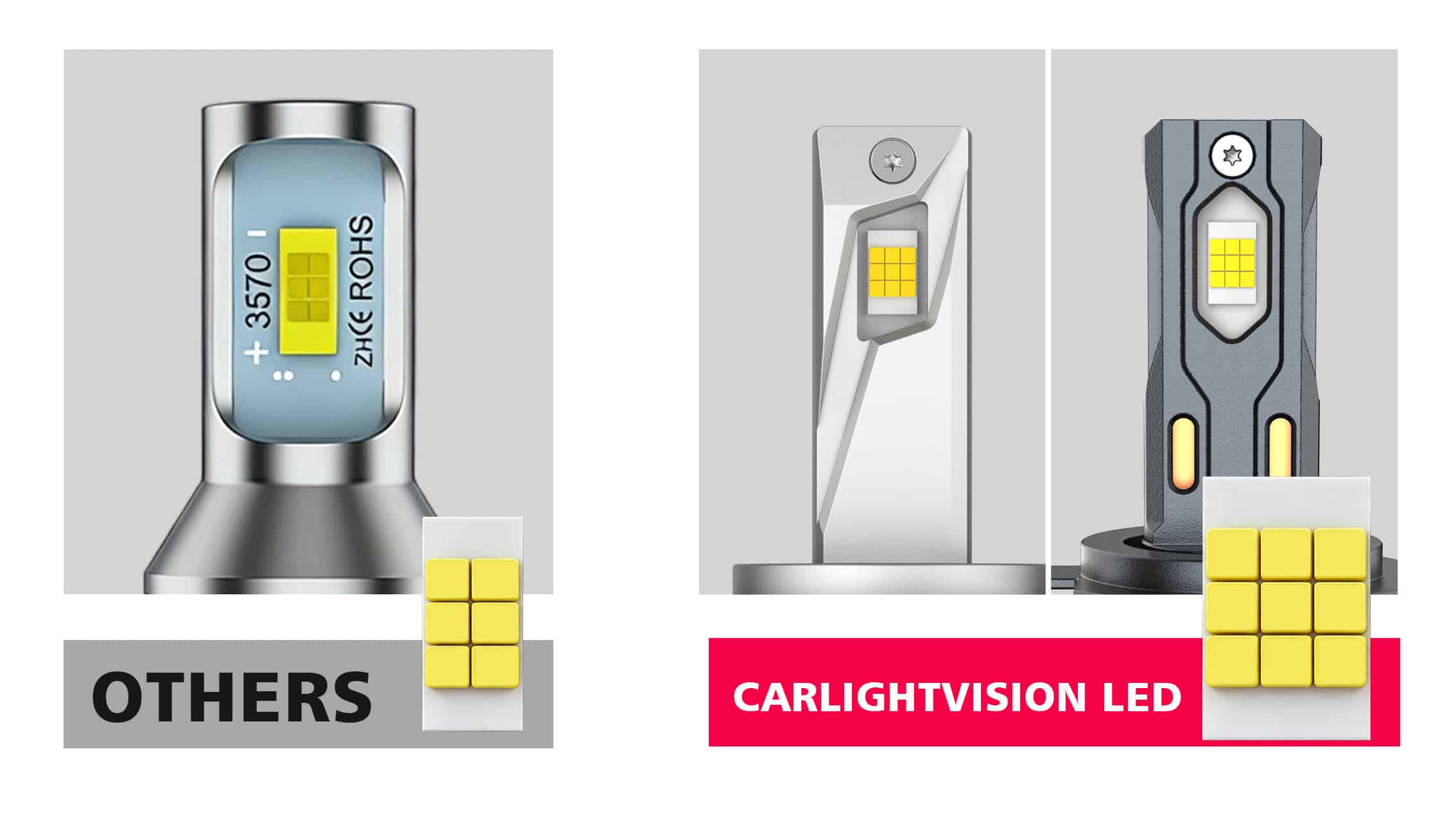
- Check the chip size: 5570 CSP chips are larger and produce more light than 3570 CSP. If the listing doesn’t specify the chip type, assume it’s the smaller, cheaper one. CSP vs COB chips — what’s the difference? →
- Look for real test data: Reputable sellers publish lux readings at a fixed distance (e.g., “128 lux at 10 meters”). If a listing only says “+500% brighter” with no test method, be skeptical.
- Price is a signal: A pair of LED bulbs for $10 with “20,000 lumens” is lying. Quality 5570 CSP bulbs with proper drivers cost $30-80 per pair.
When do you need CANbus?
- You need CANbus-decoded LED bulbs if your vehicle is:
- Must-have: VW, Audi, BMW, Mercedes, Skoda (post-2004)
- Recommended: Ford, Chevrolet, Jeep, Volvo, Peugeot (post-2010)
- Usually fine without: Most pre-2005 vehicles, many Asian-market cars, older trucksWithout CANbus decoding, you may see dashboard warning lights, hear warning chimes, experience flickering, or have the bulbs shut off automatically.
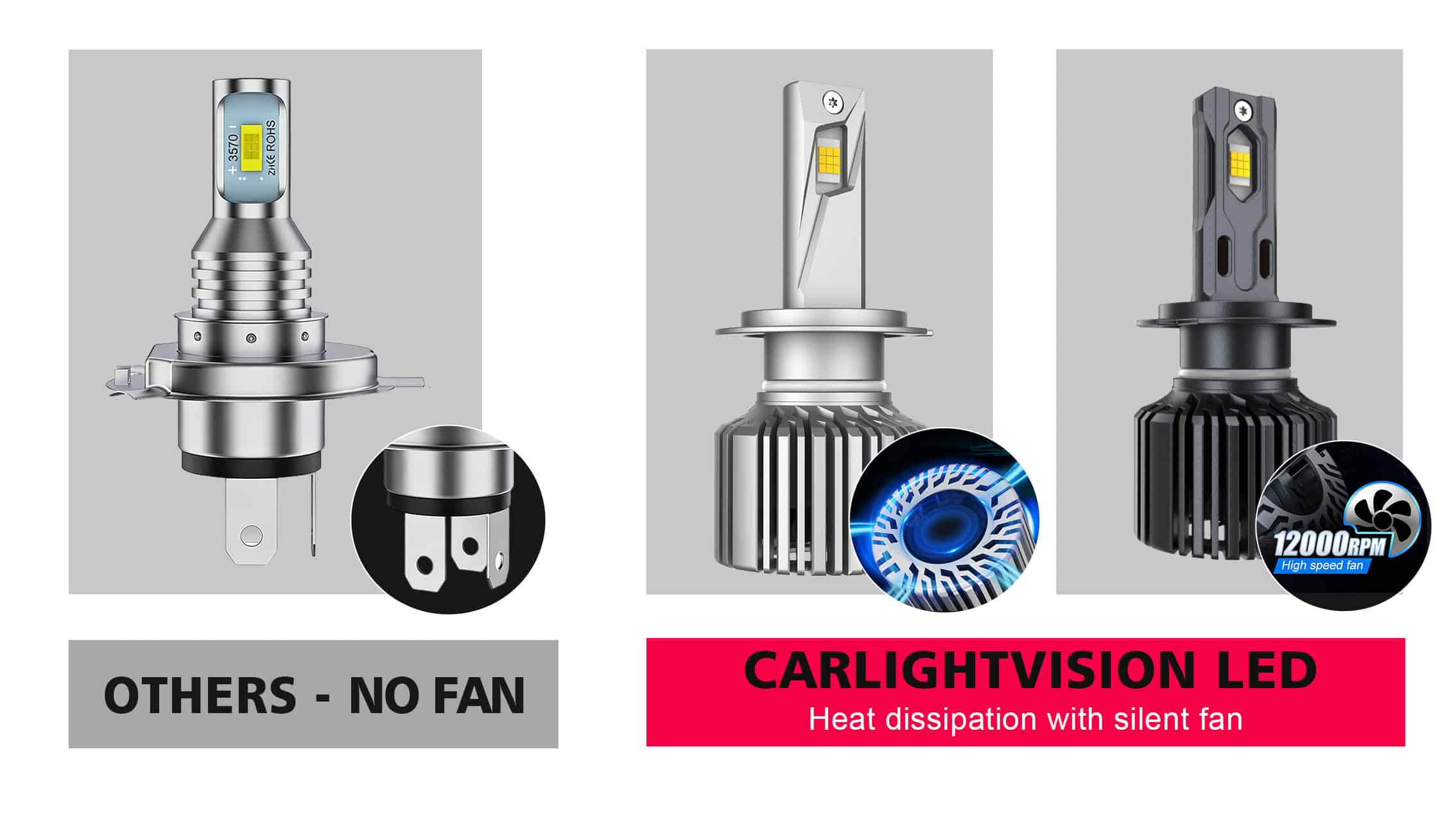
Fan vs fanless cooling — which is better?
LED chips hate heat. How a bulb dissipates heat directly determines its lifespan and brightness consistency.
- Fan-cooled: A small built-in fan actively pulls air through the heat sink. Better cooling = brighter output and longer life. Slightly larger, and the fan can fail (though quality fans last 30,000+ hours). Best for most vehicles.
- Fanless (passive): Uses a large aluminum heat sink with no moving parts. More compact (fits tight dust covers), completely silent. Slightly less cooling efficiency, so output may be lower. Best for vehicles with very limited space behind the headlight.
5 Common Mistakes When Buying LED Bulbs
Mistake 1: Buying the wrong bulb type. “It said universal fit” — there’s no such thing. H1, H4, and H7 have different bases. Always confirm your bulb type first.
Mistake 2: Believing “20,000 lumen” claims. A single LED bulb cannot produce 20,000 lumens. That’s brighter than a stadium floodlight. Real per-bulb output is 1,500-2,500 LM for quality bulbs.
Mistake 3: Ignoring CANbus. If you drive a German car and buy non-decoded LEDs, you’ll get error codes and flickering. Check compatibility before ordering.
Mistake 4: Choosing 8000K+ blue bulbs. Blue-tinted light (8000K, 10000K, 12000K) looks cool but produces less visible light and causes glare in rain/fog. 6000K is the legal and optimal white for visibility.
Mistake 5: Not re-aiming headlights after install. LED chips are positioned differently from halogen filaments. Even quality LEDs need beam height adjustment after installation to avoid glare and pass inspection.
Real Test Data
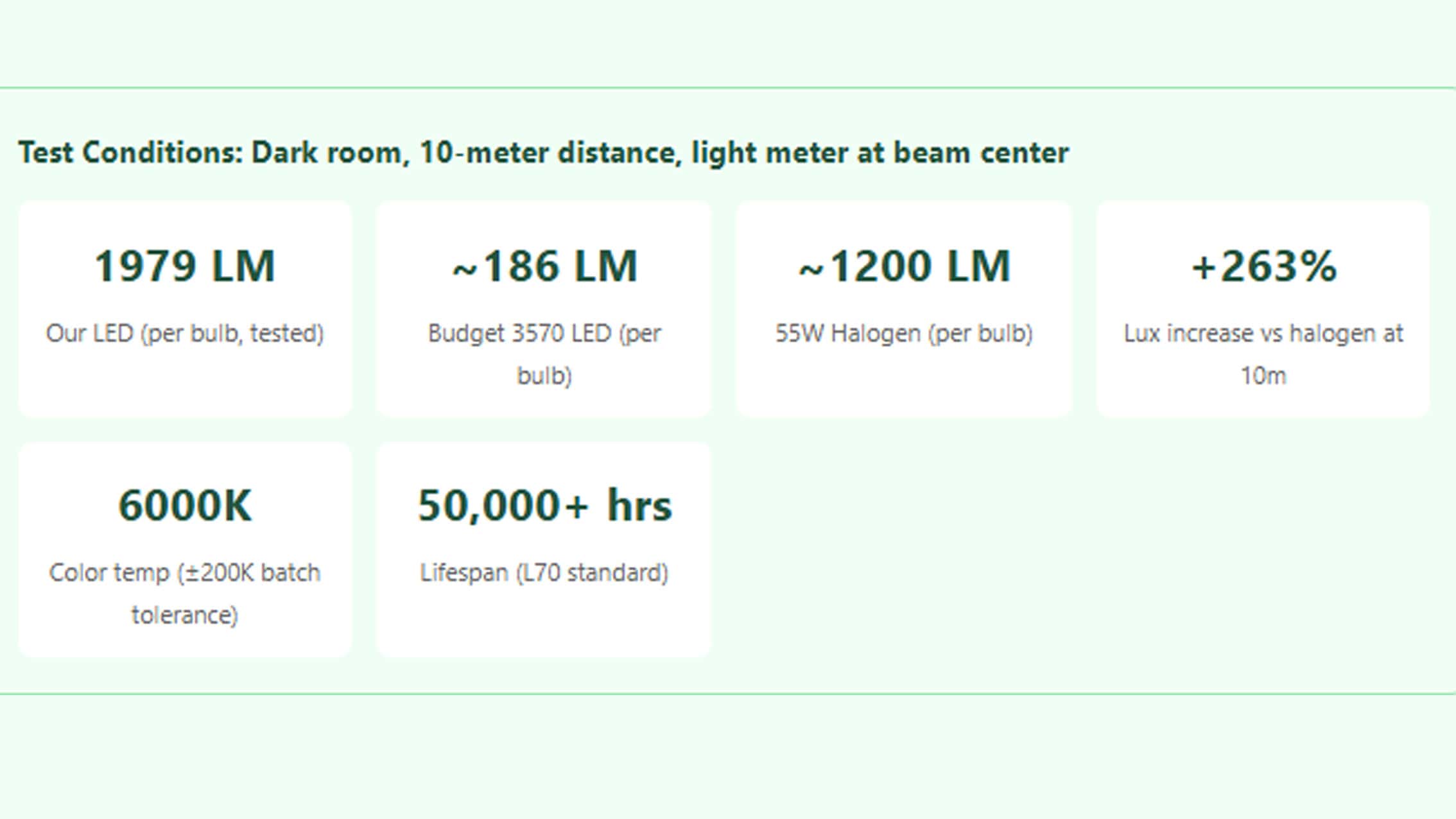
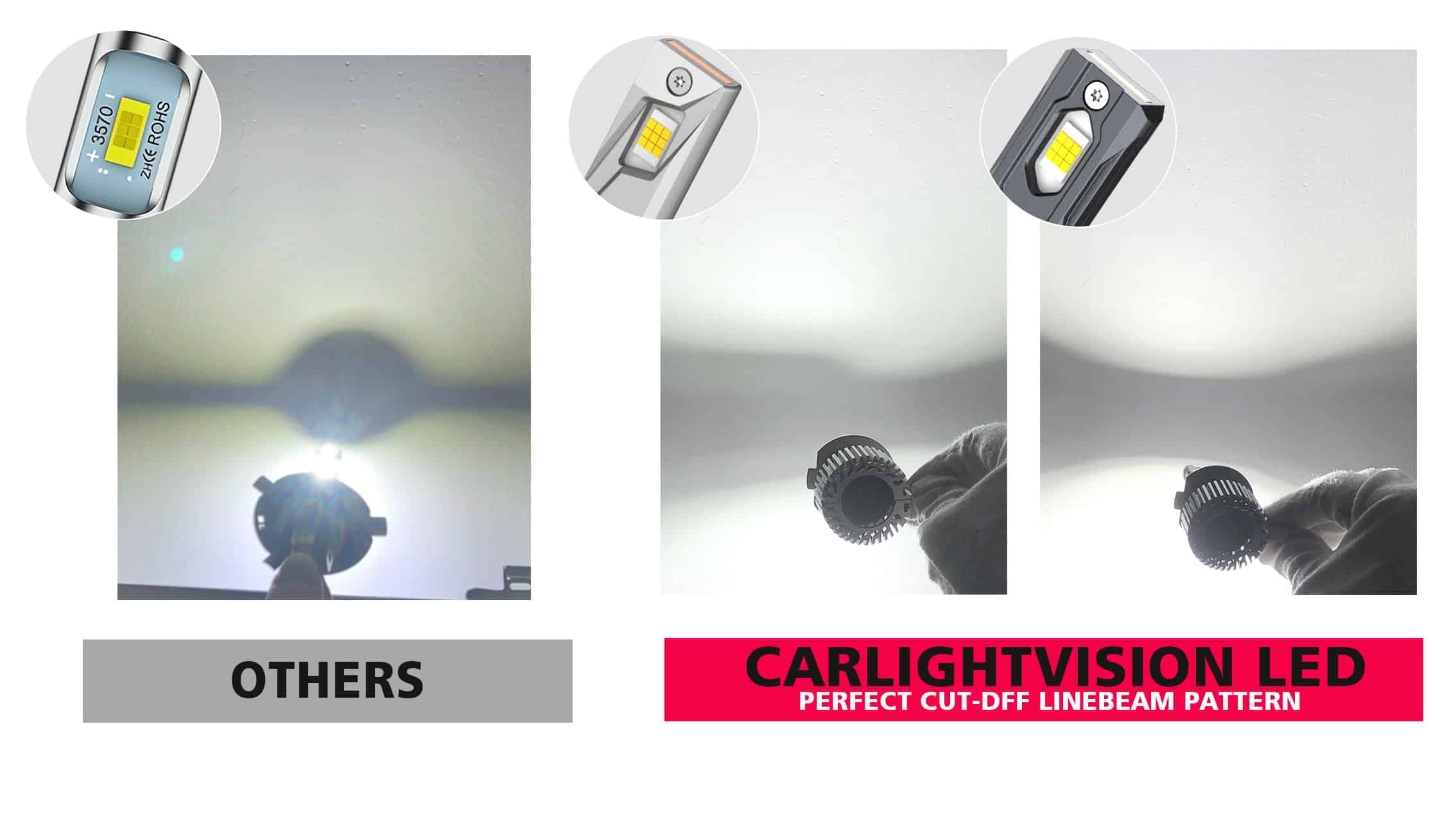
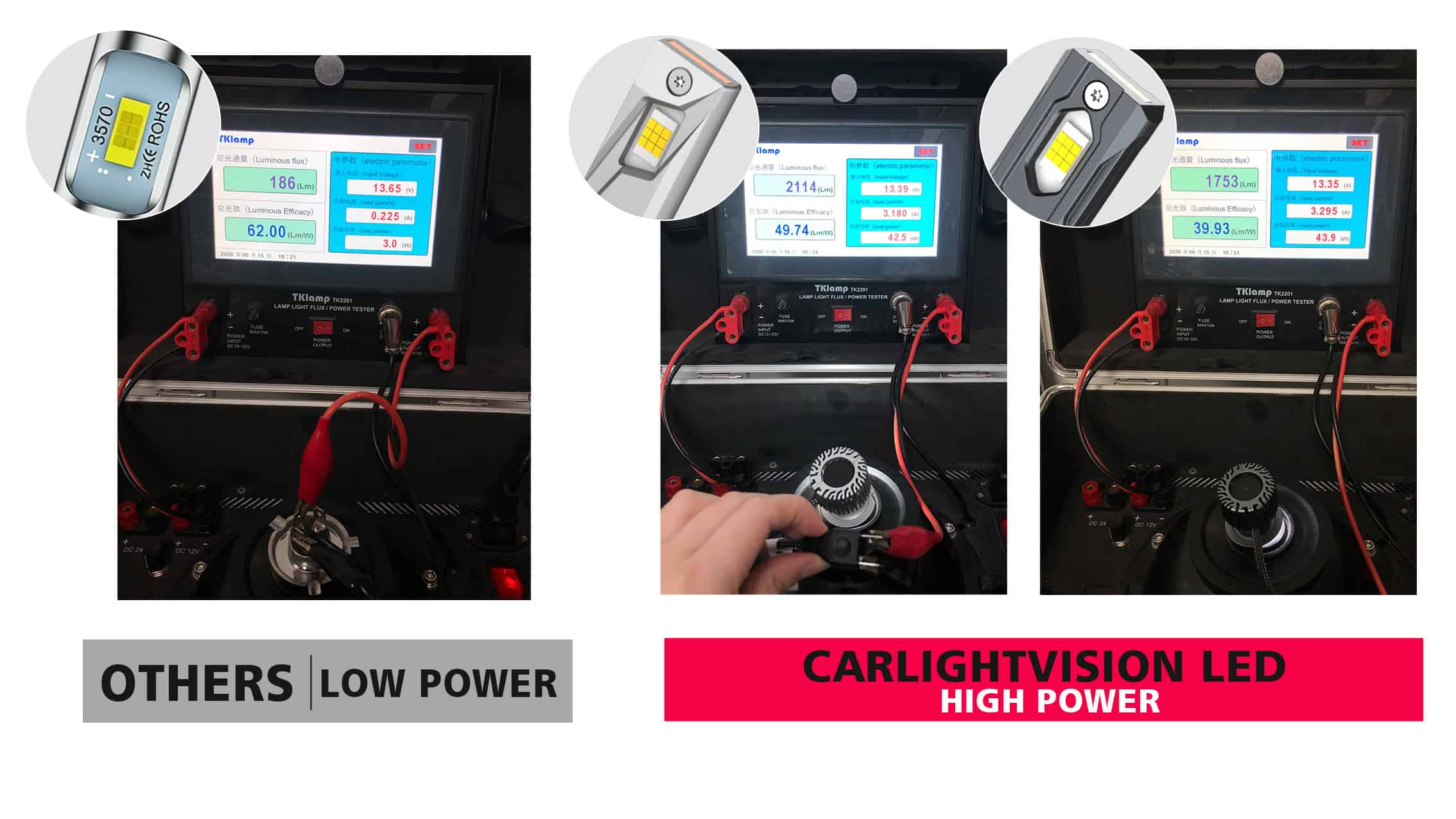
We tested our 5570 CSP LED bulbs against a standard 55W halogen bulb and a typical budget 3570 CSP LED in a controlled lab environment. Here are the results:
Additional testing notes:
- Every bulb undergoes a 48-hour continuous aging test before packaging — bulbs that flicker or fail during this period are rejected.
- Operating temperature range verified: -40°C to +80°C (cold chamber and heat chamber tests).
- Waterproof rating verified: IP68 (1.5m submersion for 30 minutes, no water ingress).
- Color consistency: paired bulbs are matched within ±200K so both headlights look identical.
How to Install LED Headlight Bulbs (5 Steps)
- Detach the adapter base from the LED headlight bulb
Separate the locking adapter base from the main LED lamp body.
- Mount the adapter base into the headlight housing first
Secure the detached adapter base inside the vehicle headlight cavity, fasten it firmly with the original metal spring clip to prevent loosening or vibration induced light deviation.
- Install and lock the LED bulb onto the pre fixed adapter base
Align the positioning notch of the LED bulb with the base, insert and twist lock the bulb in place. Ensure the LED chips are positioned horizontally (left right direction) to guarantee correct light cutoff and beam pattern.
- Connect the power connector to the factory vehicle wiring harness
Plug the LED power connector firmly into the original car power socket. Verify a tight, stable connection to avoid intermittent power failure. Route wires neatly without squeezing or damaging cables.
- Refit and close the headlight dust-proof cover
Install the rubber dust cap back onto the rear of the headlight housing. Make sure the cover is completely sealed to prevent moisture, dust and water ingress inside the lamp chamber.
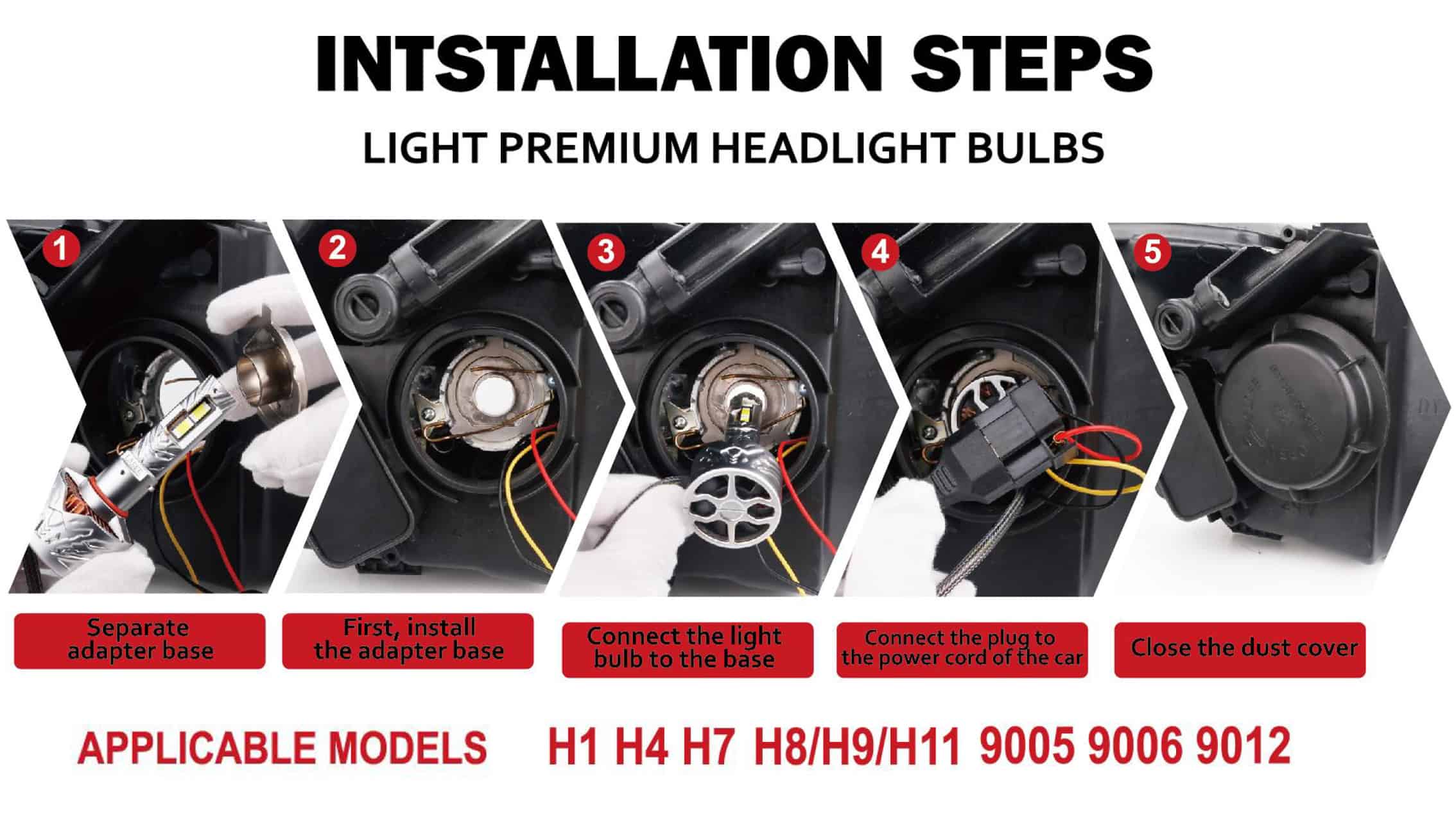
After installation: Do not touch the LED bulb light‑emitting chip with bare hands during installation. Wear clean gloves to avoid grease contamination which will shorten bulb service life.
Our Recommendation
After testing dozens of LED bulbs on the market, we recommend our 5570 CSP series for drivers who want real brightness without the common problems of cheap LEDs. Here’s how it compares to a typical budget alternative:
| Specification | Carlightvision bulbs | Cheap LED |
| Chip | 5570 CSP | 3570 CSP |
| Lumens/bulb | 1979LM(TEST) | 186LM |
| Power/bulb | 30-45W | 10-15W |
| Voltage | 12V/24V | 12V only |
| Color Temp | 6000K(consistant) | 6000-6500K |
| Temp Range | -40℃-+80℃ | -20℃-+50℃ |
| Waterproof | IP68 | IP67 |
| Lifespan | 50000+hrs | 30000hrs |
| Certification | CE, DOT, EAC, FCC, RoHS, UL, ECE,E-MARK + more | CE,RoHS |
Upgrade Your Vehicle’s Lighting Today
At Car Light Vision, we offer reliable fog lights and brighter headlight upgrades designed for better safety, brightness, and easy installation. Whether you’re upgrading a single vehicle or need bulk LED solutions, our experts can help you choose the right fit.
Contact us today for personalised recommendations, pricing, and wholesale lighting solutions.
FAQs
Q1: Can I use H7 instead of H1?
No. H7 and H1 have different base designs (PX26d vs P14.5s) and won’t physically fit each other’s sockets. Even with an adapter, the filament/chip position would be wrong, causing poor beam pattern and glare. Always use the bulb type specified for your vehicle.
Q2: Will H4 fit H7?
No. H4 uses a three-prong P43t bayonet base; H7 uses a two-prong PX26d base. They are completely different sizes and shapes. Forcing them can damage the housing or wiring.
Q3: Is H7 brighter than H1?
In halogen form, both are typically 55W and produce similar raw lumens (~1000-1500 LM). The difference is beam pattern — H7 spreads wider with a better cutoff, H1 focuses narrower. In LED form, brightness depends on chip quality, not bulb type. Quality H1 and H7 LEDs from the same manufacturer will have similar output.
Q4: Which bulb type is the brightest?
Brightness is determined by the bulb’s power and chip quality, not by H1/H4/H7 type. A quality H7 LED (1979 LM) will be brighter than a cheap H4 LED (186 LM). For halogen, H4 high beam (60W) is slightly brighter than H1/H7 (55W) because both filaments light up simultaneously.
Q5:Which lasts longer — H1, H4, or H7?
Halogen lifespan is similar across all three types (400-1,000 hours typical). H4 may burn out slightly faster because the high-beam filament gets more use. LED bulbs last 30,000-50,000+ hours regardless of type, depending on build quality and cooling.
Q6:Can I replace halogen with LED myself?
Yes, in most cases. LED bulbs are plug-and-play — same socket, same wiring. Installation takes 10-30 minutes per side. The main challenges are CANbus compatibility (German cars) and dust cover fitment (some LEDs with fans are longer). See our installation guide above for step-by-step instructions.
Q7:Do LED bulbs fail vehicle inspection?
Quality LEDs with proper beam alignment pass inspection in most countries. The key factors are: correct beam pattern (no excessive glare), color temperature under 6500K (6000K is ideal), and proper aim. Cheap LEDs with scattered light or blue 8000K+ color often fail. Always re-aim headlights after installing LEDs.
Q8:Can LED headlights blind other drivers?
Only if they’re poorly designed or incorrectly aimed. Quality LED bulbs are engineered with chip placement matching the original halogen filament position, so they project through the reflector correctly with a proper cutoff line. Cheap LEDs with misaligned chips scatter light upward, causing glare. Always buy quality bulbs and aim them properly.
Q9:Why is my LED bulb flickering?
The most common cause is CANbus incompatibility — the car’s electrical system doesn’t recognize the low-power LED and sends intermittent power. Other causes: loose connection, faulty bulb, or insufficient power. Solution: use CANbus-decoded bulbs, check connections, or install a load resistor.
Q10:Do I need a CANbus decoder?
If you drive a post-2004 VW, Audi, BMW, Mercedes, or Skoda — yes, almost certainly. Post-2010 Ford, Chevrolet, Jeep, Volvo, and Peugeot also usually need it. Older vehicles and many Asian-market cars typically don’t. When in doubt, choose bulbs with built-in CANbus decoding — it doesn’t hurt if you don’t need it.
Q11:How do I know my bulb type?
Three ways: (1) Check your owner’s manual bulb specification section. (2) Remove the old bulb and read the type printed on the base (most reliable). (3) Use an online bulb finder with your year/make/model. Note: low beam and high beam may use different types, so check both.
Q12:What does 6000K mean ?
6000K (6000 Kelvin) is the color temperature of the light — it produces a crisp, pure white similar to daylight. Lower numbers (3000K) are yellow/warm; higher numbers (8000K+) are blue. 6000K is the optimal balance for maximum visibility and legal compliance. Blue-tinted 8000K+ bulbs actually reduce visible light and cause glare.
Q13:Are LED bulbs waterproof?
Quality LED bulbs are IP67 or IP68 rated, meaning they’re sealed against dust and water. Our bulbs are IP68 — the highest rating, fully submersible. However, the headlight housing itself must also be properly sealed to prevent condensation inside the lens.
Q14:How long do LED headlight bulbs last?
Quality LED bulbs with proper cooling last 30,000-50,000+ hours. At 1 hour of night driving per day, that’s 80-130+ years — realistically, they’ll outlast the car. Cheap LEDs with poor cooling may fail in months due to overheating. Look for fan cooling, aluminum heat sinks, and published lifespan ratings.
Q15:Do LED bulbs work in 24V trucks?
Only if they’re rated for 12V/24V universal. Most budget LEDs are 12V-only and will burn out instantly in a 24V truck, bus, or heavy vehicle. Our 5570 CSP bulbs support 12V-24V, making them suitable for both cars and commercial vehicles.
Q16:My car uses H4 — do I lose high beam with LED?
Not with quality H4 LEDs. Good dual-beam H4 LEDs have properly positioned chips for both low and high beam, and both functions work exactly like the original halogen. Cheap H4 LEDs sometimes only work on high beam or have a poor low-beam pattern — another reason to buy quality.
Q17:Can I use LED bulbs in projector headlights?
Yes, but results vary. Projector housings are designed for a specific light source position. Quality LEDs with chip placement matching the halogen filament work well in projectors. Some projector housings (especially those designed for xenon/HID) may not work well with LEDs due to different focal points. Check user reviews for your specific vehicle.
Q18:What’s the difference between CSP and COB LED chips?
CSP (Chip Scale Package) chips are small, individual LED dies mounted directly to the substrate — they closely match the size and position of a halogen filament, producing a better beam pattern. COB (Chip On Board) chips are larger arrays of many tiny LEDs — they produce lots of raw light but often scatter it because the light source is too large. CSP is generally preferred for headlight use.
Written by
Mark Yeung
25 years in automotive lighting