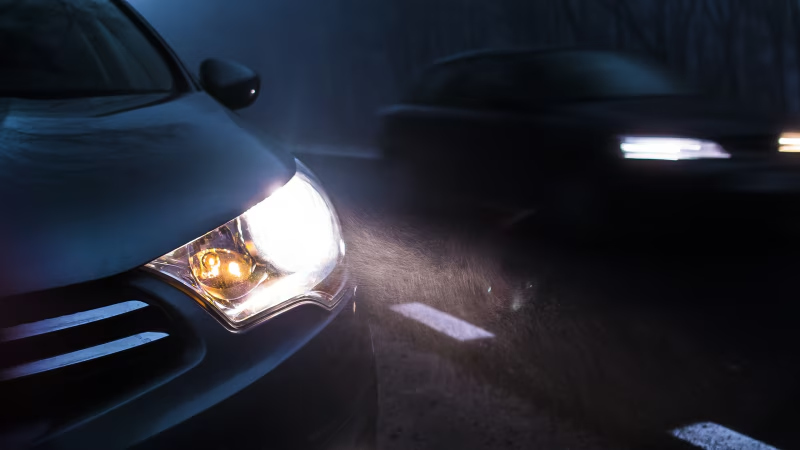
Low beams are the best headlights for driving in fog because they reduce glare and provide better road visibility. High beams often make visibility worse by reflecting light back from water droplets in the fog, while fog lights can further improve visibility in dense conditions.
However, many drivers are unsure when to use high beams, low beams, or fog lights. Using the wrong lights can reduce visibility and increase the risk of accidents.
In this guide, you’ll learn why high beams perform poorly in fog, how low beams compare to high beams in real-world driving conditions, when to use each type of light, and the common mistakes drivers should avoid when driving in foggy weather.
Why High Beam Headlights Make Fog Visibility Worse?
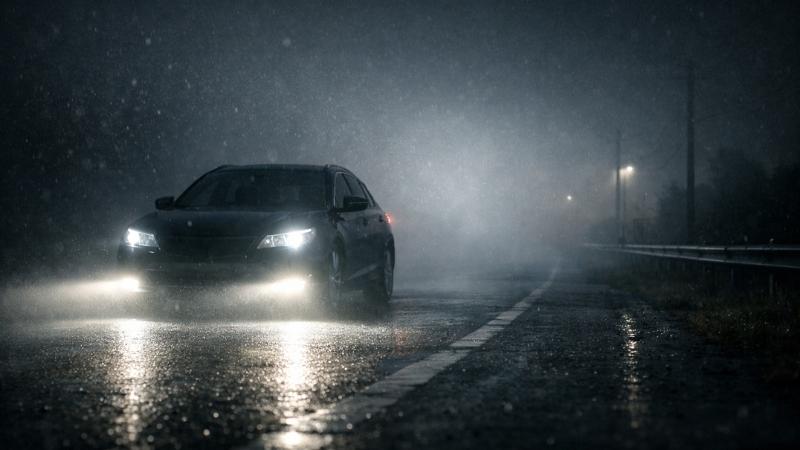
Fog contains suspended water droplets that serve as microscopic mirrors. When the bright, straight-lined light rays from the high beam hit these droplets, they get reflected off and bounce back towards the driver. As a result, the driver gets dazzled, and the visibility becomes even worse.
When these intense light rays bounce back, they accumulate in front of the windshield and create a visual white wall. As a result, the already hazy vision of the road turns blurry. This phenomenon of light bouncing back towards the source and scattering is called backscattering.
So, in fog, high beam headlights don’t illuminate the road ahead. Instead, it creates an intense, blinding glare for the driver that further impairs vision. The Federal Highway Administration reports that over 38,700 vehicle crashes occur every year due to compromised visibility.
One of the reasons is the wrong choice of headlights in foggy conditions. The survey conducted by Tempcover revealed that out of 2000 drivers, 17% assumed full-beam headlights provide better visibility.
Turning high beams on in fog also compromises the safety of oncoming vehicles. The sharp, intense light rays also dazzle the oncoming drivers and other vehicles.
High Beams vs Low Beams in Fog
A survey conducted by the Royal Automobile Club (RAC) in 2026 revealed that about 63% of drivers get dazzled by the vehicle lights. It is because the majority of drivers don’t understand the true functionality of high beam and low beam headlights. This section will compare high beams vs low beams in the fog setting.
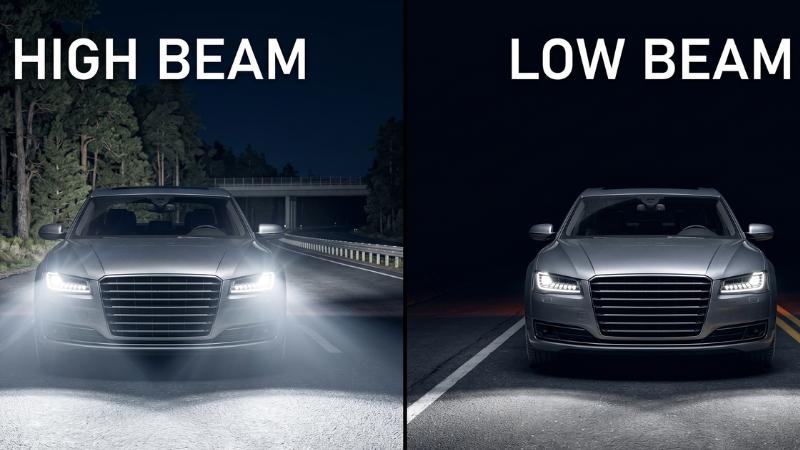
High Beam Headlights in Fog
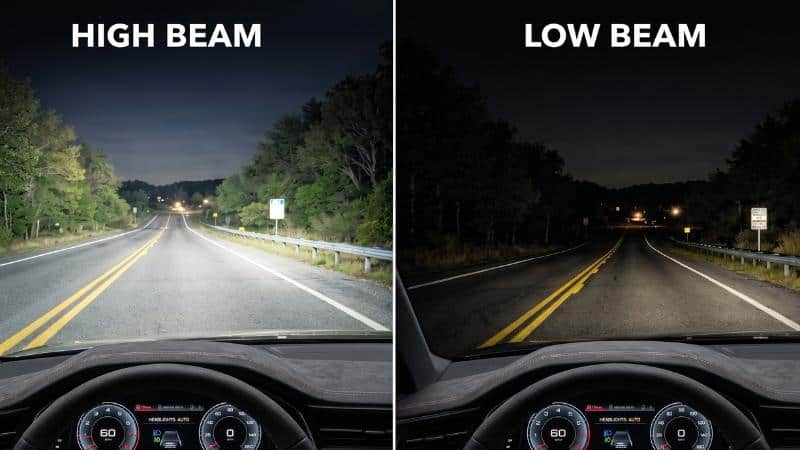
High beams are powerful lights that can illuminate up to 350 – 400 feet ahead in normal conditions. However, in thick fog, they merely illuminate the road to a distance of a few inches. It is because their straight-line light rays cannot cut through the fog.
The suspended water droplets mimic mirrors. Since high beams produce highly intense light, a significant amount of that light is reflected back with considerable brightness. As a result, the white-wall phenomenon comes into effect.
Pros
High beams generally have more disadvantages than advantages in foggy conditions. The pros of high beams are only applicable in light fog.
- In very thin fog, high beam headlights may help in detecting distant obstacles or sharp turns, especially when driving at night.
- Having a broad beam spread, they can improve the peripheral field of vision. However, it is not true in strong fog.
- With intense light output, high beams can temporarily increase visibility. Yet, it is applicable only in patchy-fog conditions.
Cons
The section below expands on the cons of using high beams in foggy weather.
- They create a strong backscattering and dazzle the driver as well as other drivers behind the vehicle.
- The sharp and intense light rays disturb the oncoming drivers and reduce their visibility by causing glare.
- Since fog reflects back most of the light, drivers often see less distance ahead despite using brighter lights.
- The white-wall effect strains the eyes and blinds the driver for a certain time span, increasing the chances of a road accident.
Low Beam Headlights in Fog
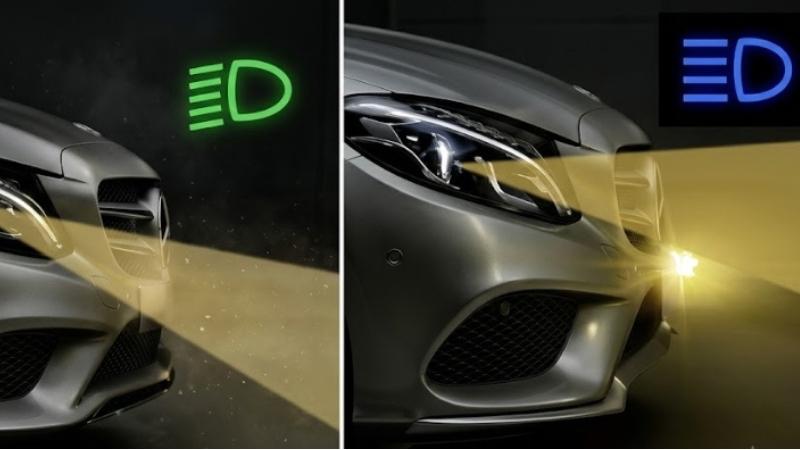
Low beams are downward-directed headlights designed to illuminate the patch of road right in front of the vehicle. The light from low beams covers about 100 – 200 feet of road ahead, even in fog.
Low-beam headlights have lower luminous intensity than high beams. It is because their purpose is to light up the road. The light beams shoot at an angle of -45° at the road instead of cutting through the fog.
Pros
This section highlights the pros of low beams when used in foggy weather.
- Low beam headlights project light downwards on the road, not into the fog. So, there is little to no reflection.
- They make the road visible and help drivers navigate better in foggy conditions.
- The lower beam angle minimizes excessive illumination and prevents the dazzling of oncoming vehicles as well.
- Since the road is adequately illuminated, it becomes easier to detect speed breakers, lane markings, signs, obstacles, and road edges.
Cons
Here are the potential cons of using low beam headlights in foggy weather.
- They are short-range beams and only cover a small area of the road.
- They don’t provide coverage for the peripheral field of vision.
- The driver may not be able to detect a distant object or obstacle far in advance.
- In dense fog, instead of low beams, fog lights are more effective as they are specifically designed for driving in fog. Fog lights have a selective yellow or amber light that is ideal for seeing through fog.
| Characterisitcs | High-Beam Headlights | Low-Beam Headlights |
|---|---|---|
| Range | A few inches in fog | Up to 100 feet in fog |
| Angle | Horizontal Rays at 0° | Rays at -45° |
| Brightness | More light and illumination | Less light and illumination |
| Reflection | Strong backscattering | Minimal backscattering |
When Should You Use High Beams?
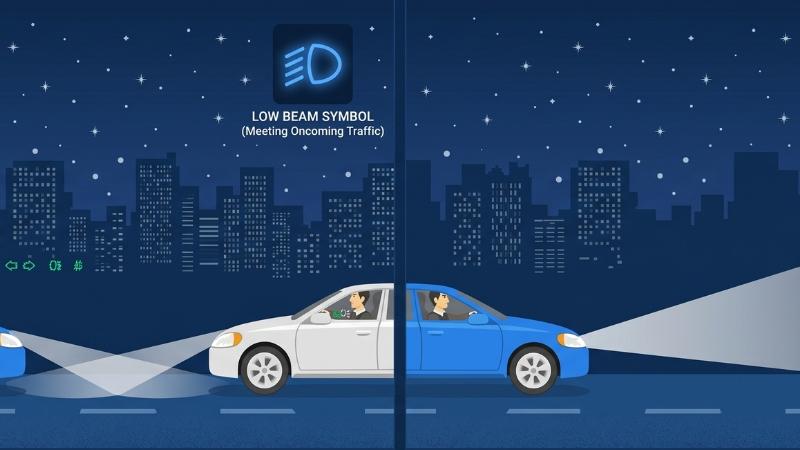
High beam headlights are most appropriate for driving in rural areas or during off-road night driving. It is also the best option for areas that are not lit up with streetlights, such as rural roads.
You can also stick to high-beam lights when driving on highways or on dark, tree-lined roads in the countryside. Research conducted by the Insurance Institute for Highway Safety (IIHS) revealed that only about 18% to 22% of drivers use high beams correctly.
In some regions, it is a requirement by law to dim or turn off your high beams when passing by oncoming traffic. You can also turn it on and off for a moment to signal a vehicle or pedestrians about your presence.
When Should You Use Low Beams?
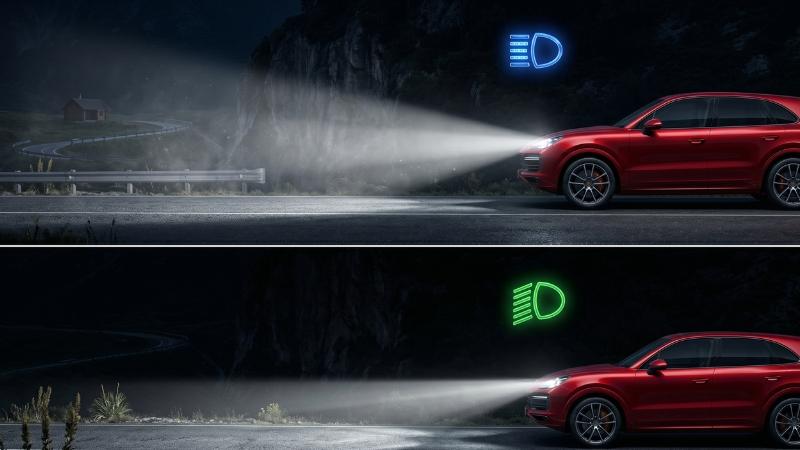
Low beams should be considered the go-to headlights in most situations. They are best suited for city driving, where the roads are already shining with streetlights.
These downwards angled lights are also best utilized in fog, snow, and rain. In such situations, low beam lights illuminate the first 50 meters of the road without dazzling. It is also suggested to switch to the low beam lights when approaching a vehicle in front of you.
Common Mistakes Drivers Make in Foggy Conditions
Driving in fog is a critical situation that requires extra caution. The following are common mistakes drivers make that you should avoid to improve safety.
- Oftentimes, drivers switch on high beams thinking they will improve visibility. In foggy conditions, fog lights or low-beam headlights are the better choice.
- Many drivers overspeed to pass through foggy patches quickly. In reduced visibility, you must slow down to have enough distance to detect obstacles.
- Another dangerous practice is tailgating without maintaining a stopping distance. Always keep a sufficient gap from the vehicle ahead and rely on your own headlights.
- During winter, daylight hours are shorter, yet some drivers continue using only their daytime running lights. You should switch on your low-beam headlights or fog lights to improve visibility. Fog lights are placed low on the front bumper to cast a beam underneath the main fog bank.
Conclusion
Every vehicle light is designed for use in particular driving conditions. Understanding when and where to use each type of light is essential, as improper usage can reduce visibility.
In foggy conditions, fog lights are the best option because they are specifically designed to minimize glare. Otherwise, low beam headlights are also an acceptable alternative.
Need Help Choosing the Right Headlights?
The best headlight for you depends on your vehicle, your driving conditions, and your visibility needs. Whether you’re replacing bulbs, upgrading your lighting, or sourcing products for your customers, choosing the right beam pattern and fitment is just as important as brightness.
At Car Light Vision, we help you find reliable headlight and fog light solutions for your vehicle or your business. Contact our team for expert advice on compatibility, performance, and wholesale options.
FAQs
Q1: Should You Use High or Low Beams in Fog?
Answer: You should use low beams when driving in fog. Low beams direct light toward the road surface, helping you see lane markings and obstacles without creating excessive glare. If your vehicle is equipped with fog lights, they can be used together with low beams for improved visibility.
Q2: When Driving in Fog, Why Should You Never Use High Beams?
Answer: High beams reflect off tiny water droplets suspended in the fog. Instead of improving visibility, the reflected light creates a bright “wall” in front of your vehicle, making it harder to see the road ahead. This is why low beams are the safer choice in foggy conditions.
Q3: What Lights Should You Use in Foggy Weather?
Answer: In foggy weather, use your low-beam headlights. If your vehicle has front fog lights, use them together with low beams for better road illumination. Rear fog lights can also improve visibility for drivers behind you when fog becomes particularly dense.
Q4: Are Fog Lights Better Than Low Beams?
Answer: No. Fog lights are designed to supplement low beams, not replace them. Low beams provide your primary forward visibility, while fog lights help illuminate the road directly in front of your vehicle and reduce glare in dense fog. The best setup is usually low beams combined with fog lights.
Q5: Should You Use Full Beams When Driving in Fog?
Answer: No. Full beams (high beams) are generally not recommended in fog because they increase glare and reduce visibility. In most foggy driving situations, low beams provide a clearer view of the road and surrounding traffic.
Q6: When Do You Use High Beams?
Answer: High beams should be used on dark, open roads with little or no street lighting when there is no oncoming traffic. They help extend your viewing distance and improve reaction time. However, you should switch back to low beams when approaching other vehicles, driving in fog, heavy rain, snow, or other conditions that can reflect light back toward you.