When shopping for LED headlight bulbs, the first decision most buyers face is: fan-cooled or fanless? But the truth is, that’s just the tip of the iceberg. Behind every “50,000-hour lifespan” claim lies a complex system of thermal management, environmental sealing, and factory quality testing that determines whether your bulbs will last months or years.
In this guide, we break down everything from cooling technology and failure mechanisms to IP ratings and factory reliability tests — so you can make an informed choice based on engineering, not marketing.
Fan vs Fanless: Two Cooling Philosophies, One Goal
All high-power LED headlights face the same fundamental problem: only 30–40% of electrical energy becomes light; the remaining 60–70% turns into heat. If that heat isn’t removed quickly, the LED chip’s junction temperature (Tj) spikes, accelerating light decay and shortening lifespan dramatically.
Manufacturers solve this problem with two distinct approaches: active (fan) cooling and passive (fanless) cooling.
Active Cooling (Fan-Cooled LEDs)
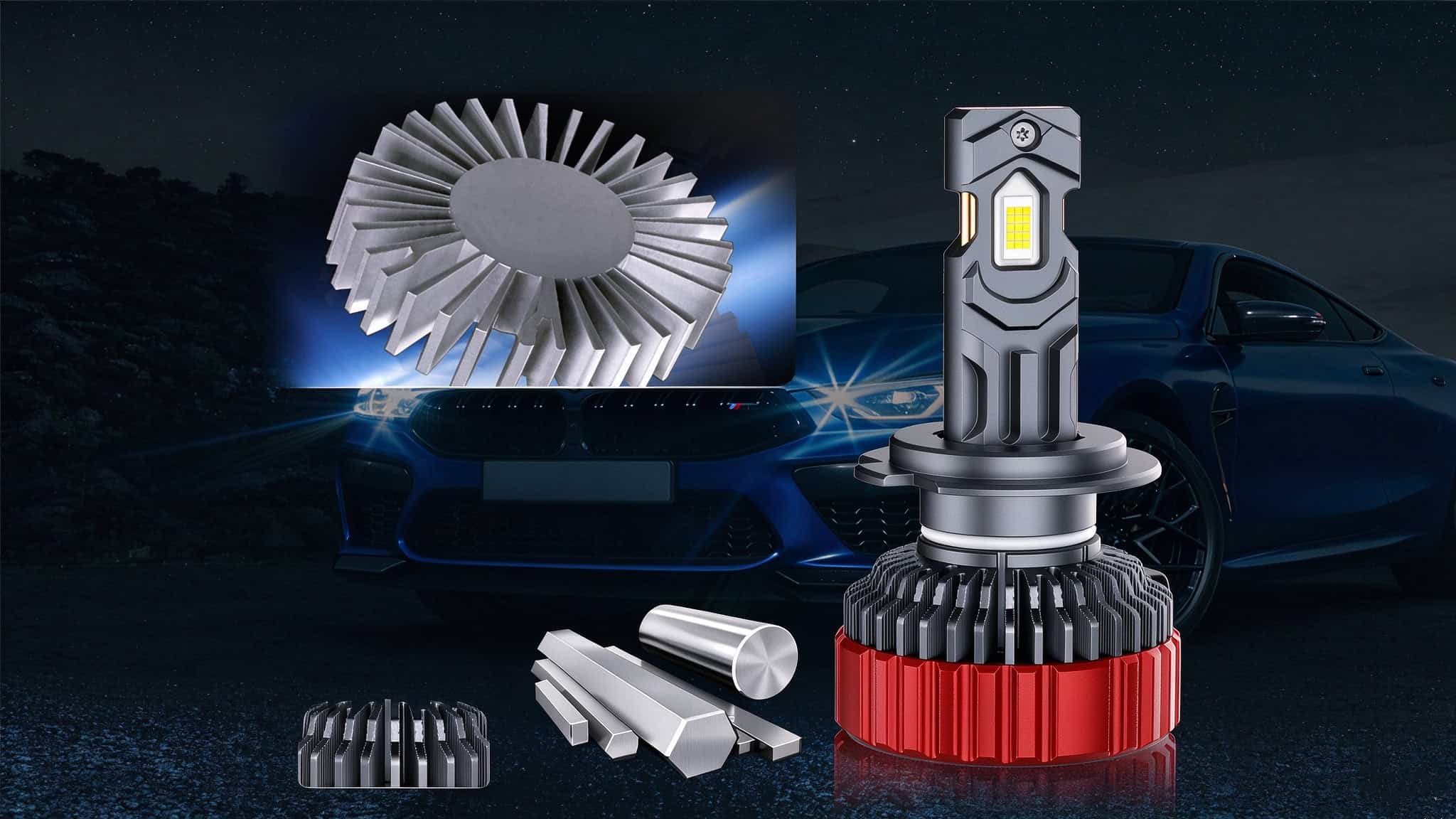
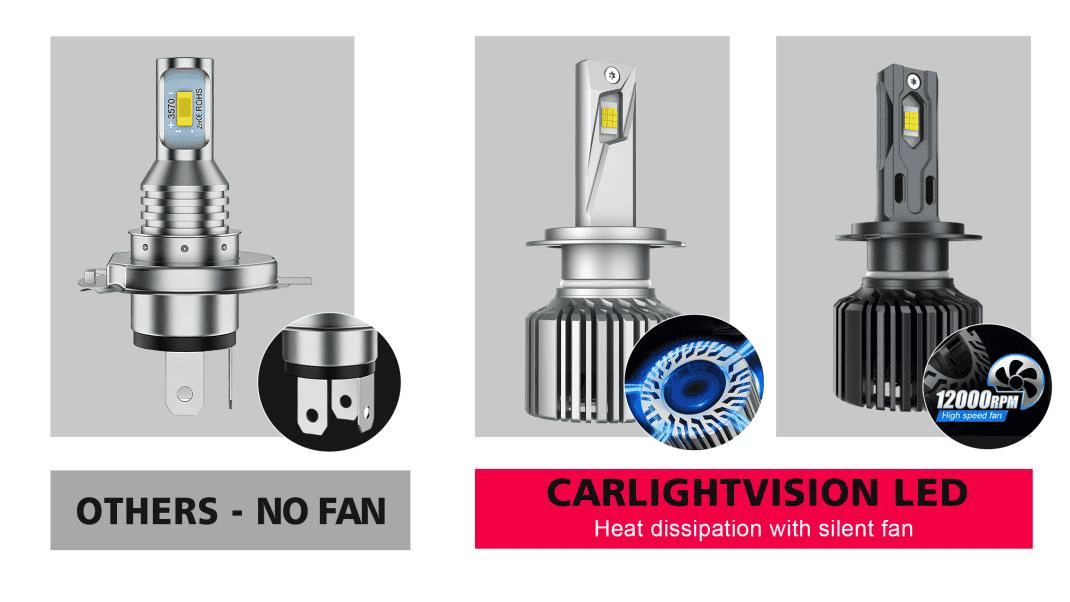
Fan-cooled designs use a built-in high-speed electric fan to force air across the heat sink fins,actively pulling heat away from the LED chip. This is the most effective method for high-wattage bulbs.
Advantages:
- Superior thermal performance — typically runs 15–25°C cooler than equivalent fanless designs
- Supports higher power output (24W–80W+) and higher lumen output (8,000–12,000+ lm)
- Compact heat sink body thanks to forced convection
- Maintains stable brightness even during extended night driving
Disadvantages:
- Moving parts mean potential fan failure over time
- Slight audible hum at close range
- Fan motor consumes additional power
- Dust and moisture can degrade fan bearings
Passive Cooling (Fanless LEDs)
Fanless designs rely entirely on natural convection and conduction through aluminum alloy heat sinks — no moving parts. Heat travels from the chip through the heat sink body and dissipates into the surrounding air passively.
Advantages:
- Zero mechanical failure points — theoretically longer service life
- Completely silent operation
- Simpler, more robust construction
- Often slimmer profile for tight headlight housings
Disadvantages:
- Limited to lower power levels (typically 12W–24W)
- Higher steady-state junction temperature
- Performance degrades in hot climates or sealed housings
- Larger heat sink diameter may cause fitment issues.
Quick Comparison Table
| Feature | Fan-Cooled LED | Fanless LED |
|---|---|---|
| Cooling method | Active forced-air convection | Passive natural conduction |
| Typical power range | 24W-80W | 12W–24W |
| Lumen output | 8,000–12,000+ lm | 200–3000 lm |
| Reliability | Good (fan is wear part) | Excellent (no moving parts) |
| Noise level | Low but audible hum | Completely silent |
| Best for | High performance, hot climates, extended night use | Moderate climates, tight spaces, urban driving |
Inside the Cooling System: How Heat Travels
Understanding why cooling matters requires looking at the full thermal path. Heat doesn’t just “disappear” — it travels through a chain of materials, and any weak link in that chain becomes a thermal bottleneck.
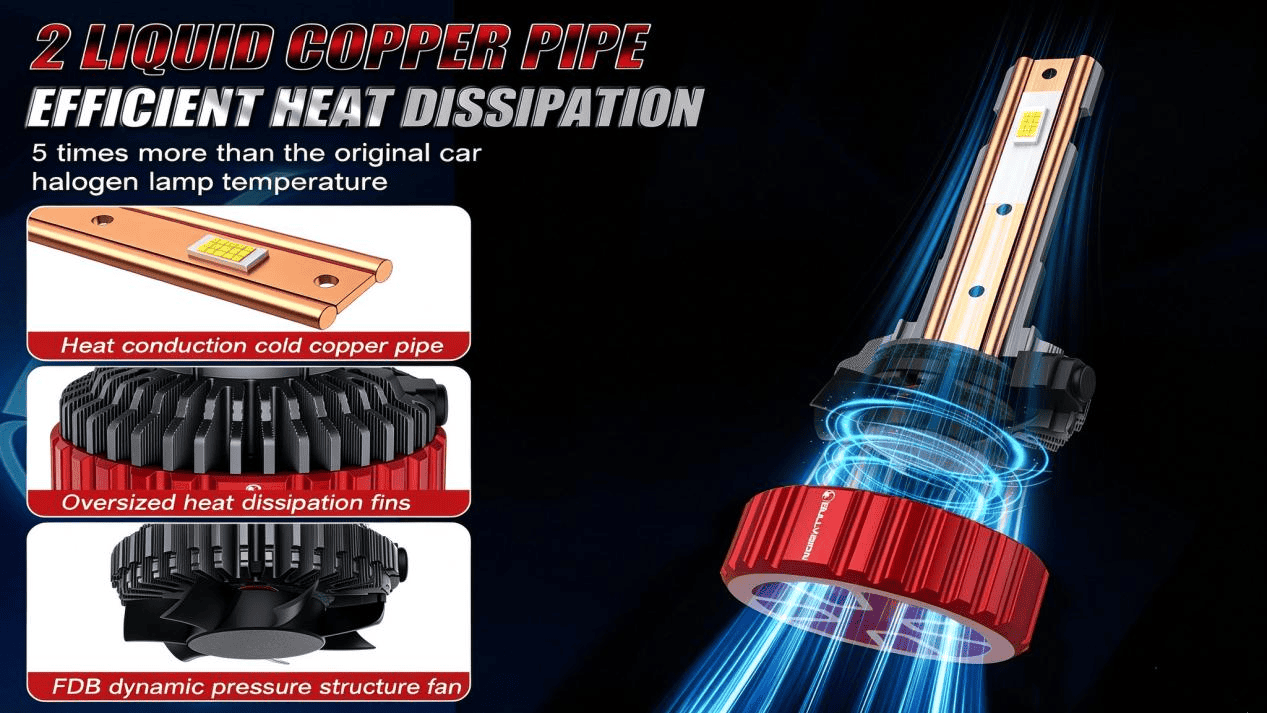
The Thermal Resistance Chain
A typical LED headlight’s heat travels along this path:
- LED PN junction — where heat is generated
- Die attach / solder layer — bonds chip to substrate
- MCPCB (Metal Core PCB) — aluminum or copper base board
- Thermal interface material (TIM) — thermal grease or pad
- Heat sink body — aluminum fins or copper pipes
- Ambient air — final heat dissipation via convection
Each layer adds thermal resistance. The total resistance determines how hot the junction gets for a given power input. The formula is simple:
Tj = Ta + (Power × Total Thermal Resistance)
This is why two bulbs with the same wattage can run at wildly different temperatures — it’s not about how much heat you make, but how efficiently you move it out.
Industry Fact: Junction temperature is the single most important factor in LED lifespan. Every 10°C increase above the recommended rating roughly doubles the rate of lumen depreciation and cuts driver capacitor life in half.
Why LEDs Fail: Heat Is the #1 Killer
- 1.Accelerated Lumen Depreciation (Light Decay)
As junction temperature rises, the LED’s semiconductor material degrades faster. The industry standard lifespan definition — L70 — means the point at which brightness drops to 70% of its original output. Poor cooling can turn a 50,000-hour rating into 5,000 hours or less.
- 2.Color Shift & Wavelength Drift
High temperatures cause the LED chip’s peak wavelength to shift (redshift) and degrade the phosphor coating. Your clean 6000K white light gradually turns yellowish or greenish — a telltale sign of thermal damage.
- 3.Driver Component Failure
The LED driver board contains electrolytic capacitors whose lifespan is highly temperature-sensitive. For every 10°C rise in operating temperature, capacitor life is cut approximately in half. A driver rated for 50,000 hours at 85°C might only last 6,000 hours at 105°C.
- 4.Solder Joint Fatigue
Repeated heating and cooling cycles cause thermal expansion and contraction. Over time, this fatigues solder joints, leading to intermittent connection, flickering, or complete failure — especially in bulbs with poor thermal design.
- 5.Catastrophic Thermal Runaway
In the worst case, excessive heat causes the chip to degrade, which makes it less efficient, which generates more heat — creating a vicious cycle that destroys the PN junction permanently.
Key Takeaway: When comparing LED bulbs, don’t just look at wattage and lumens. Ask: how does it keep the chip cool? That answer predicts real-world longevity far better than any advertised lifespan number.
Temperature Testing: How We Measure Real-World Performance
Advertised specs are one thing — real-world performance inside a sealed headlight housing is another. Professional temperature testing reveals the truth about thermal design quality.
Standard Testing Methods
1.Steady-State Junction Temperature Test
The bulb is mounted in a sealed test fixture (simulating a headlight housing) and powered on until temperatures stabilize. Thermocouples measure heat sink temperature, and junction temperature is calculated using known thermal resistance values Check out our Temperature test video :
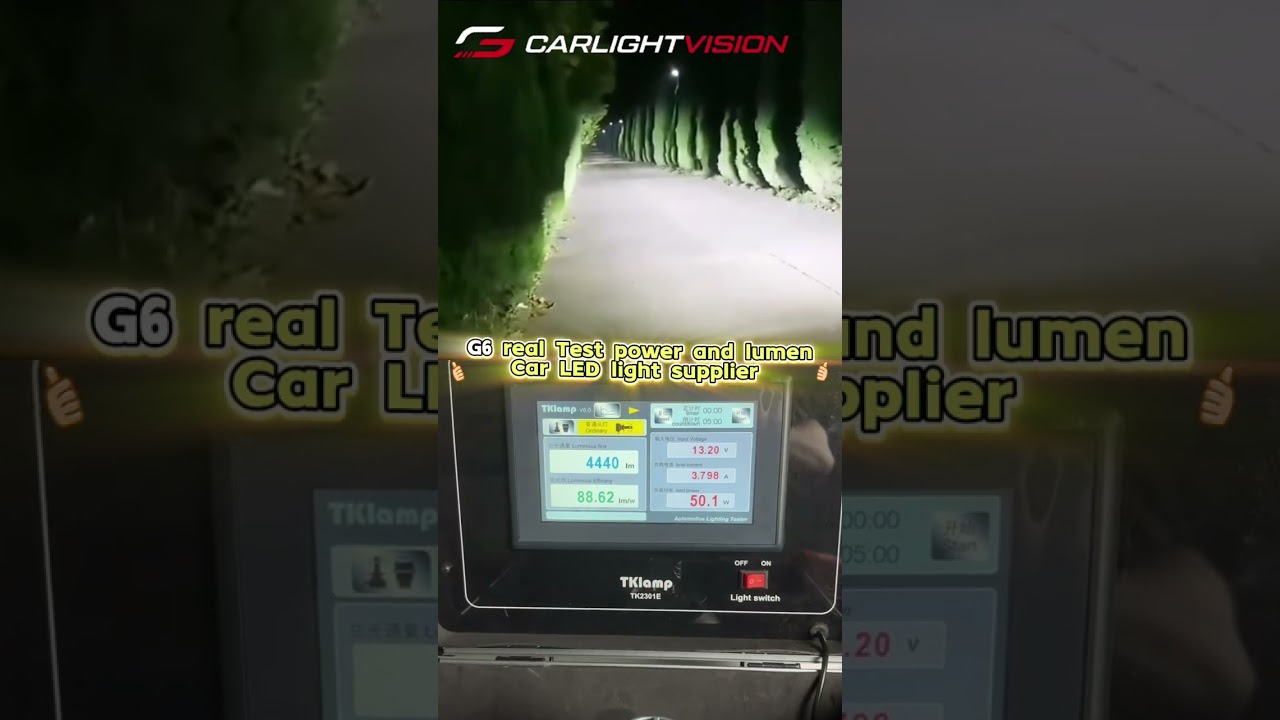
What to look for: A quality 60W fan-cooled bulb should maintain a heat sink temperature below 85°C at 25°C ambient. Fanless equivalents typically run 10–20°C hotter
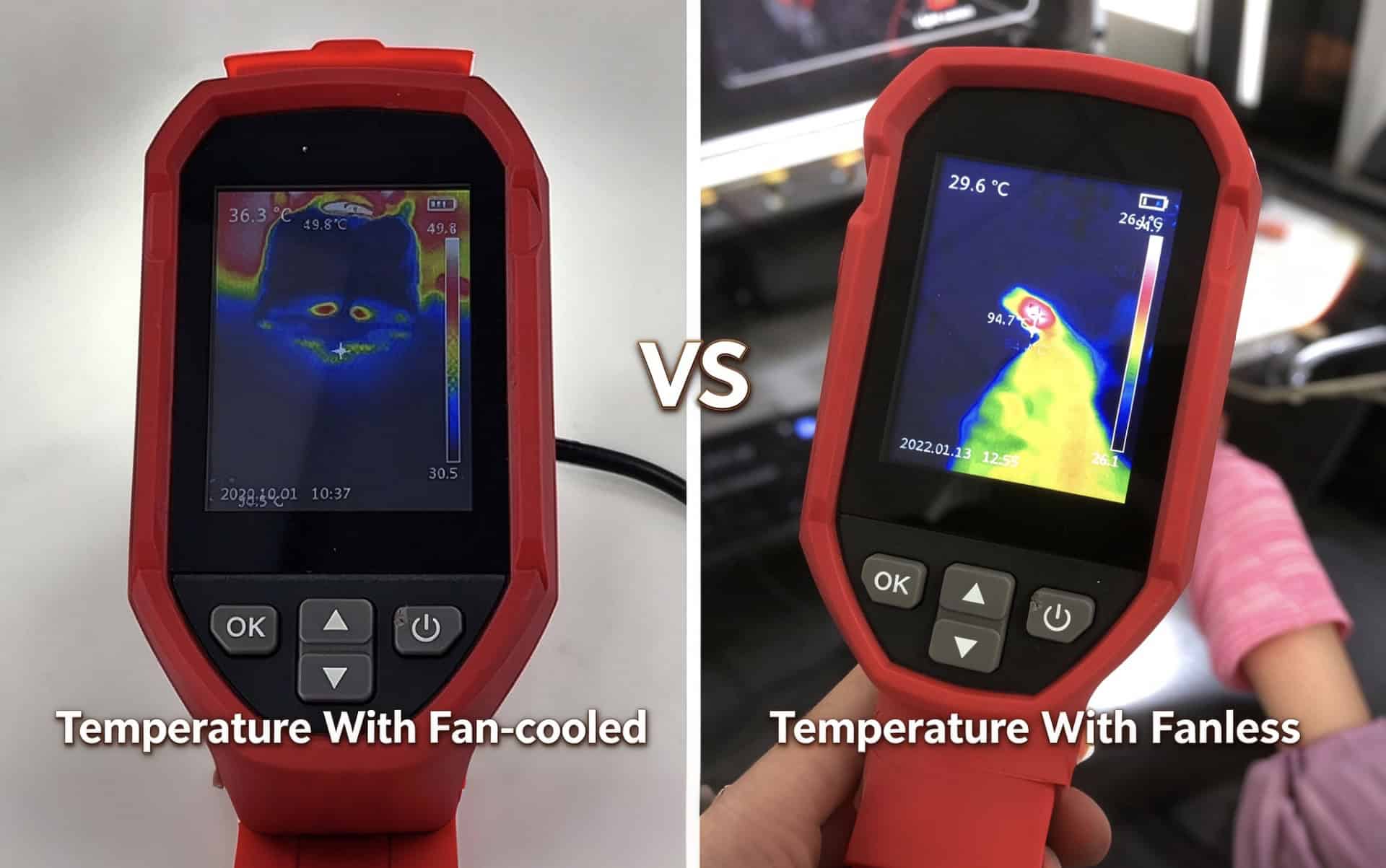
2.Thermal Imaging Analysis
Infrared cameras map surface temperature distribution across the bulb body. This reveal shotspots that indicate poor internal heat spreading or inadequate TIM application.
3.Light Output vs. Time Curve
Brightness is measured at startup, 5 minutes, 30 minutes, and 1 hour. A well-cooled bulb will maintain 90%+ of its initial brightness after 30 minutes. A poorly cooled bulb may drop 20–30% as thermal throttling kicks in.
4. Cold-Start to Hot-Stabilized Cycle
Testing from -40°C cold start through full heat-soak simulates real winter driving conditions and verifies that components can handle thermal expansion stress.
Red Flag: If a manufacturer only publishes “instant on” lumen numbers and never mentions 30-minute stabilized output, they’re probably hiding significant thermal light decay.
Factory Reliability Testing: What Happens Before Your Bulb Ships
Any LED bulb can work for a week. The question is whether it will still work in 3 years. Reputable manufacturers validate products through an extensive battery of reliability tests before mass production.
Core Reliability Test Suite
1.Burn-In / Aging Test
Every production batch undergoes a powered burn-in period (typically 3–24 hours) at elevated temperature. This screens out early-life failures — the “infant mortality” phase of the product bathtub curve. Quality factories reject any unit that fails during burn-in before shipment.
2.Thermal Cycling Test
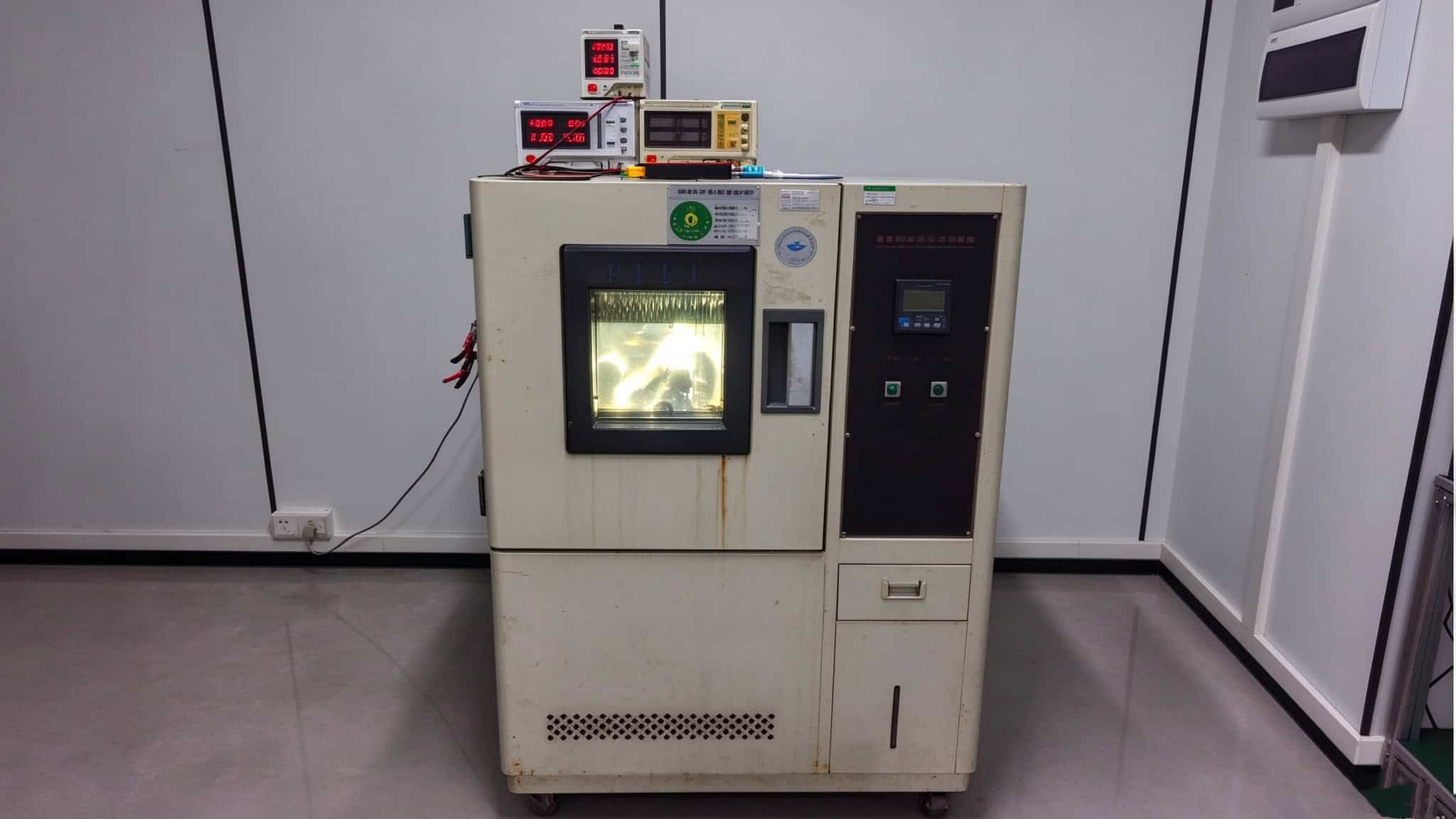
Bulbs are subjected to repeated temperature swings (e.g., -40°C to +85°C) over hundreds of cycles. This tests solder joint integrity, material compatibility, and resistance to thermal fatigue. Standard automotive qualification requires 500+ cycles.
3.Thermal Shock Test
More extreme than cycling — rapid temperature transitions (within seconds) from extreme cold to extreme heat. Simulates scenarios like driving through a cold river with hot headlights on. Verifies that lenses and housings don’t crack from sudden thermal stress.
4.Vibration & Mechanical Shock Test
Simulates road vibration and impact conditions per automotive standards (ISO 16750). Bulbs are mounted on vibration shakers for extended periods to verify that internal components don’t loosen and heat sink assemblies remain rigid.
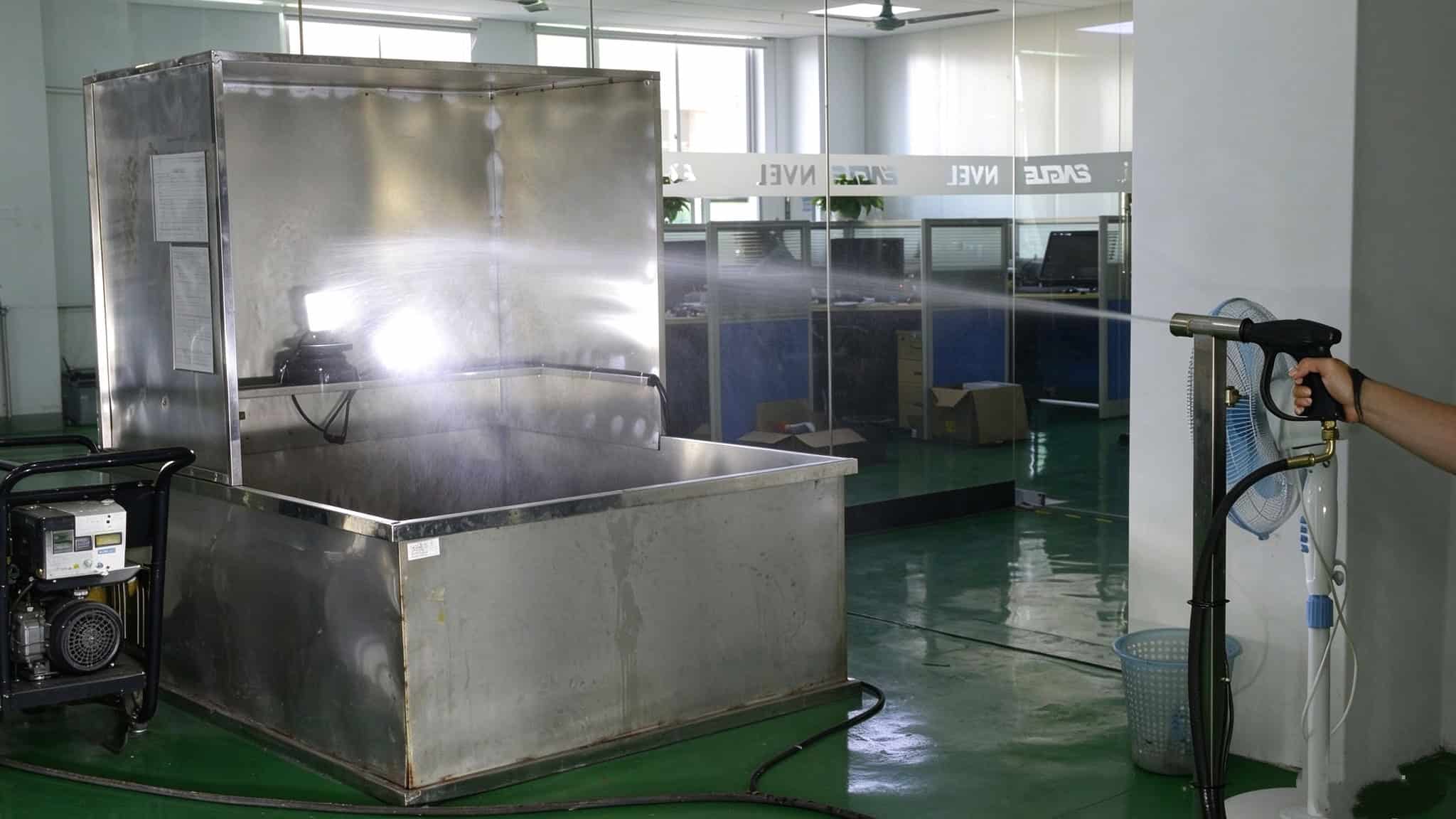
5.Salt Spray / Corrosion Test
Exposes metal components to salt fog environment for specified durations (24–500 hours). Critical for vehicles in coastal areas or regions that use road salt in winter.
6.EMC / CANBUS Compatibility Test
Automotive electronics must meet strict electromagnetic compatibility standards. Testing ensures the bulb doesn’t generate radio interference, trigger dashboard error codes, or cause flickering on CANBUS-equipped vehicles.
Why This Matters to You
A manufacturer that skips reliability testing can sell cheaper bulbs — but you pay the price in premature failures. When comparing suppliers, ask about their testing protocols and whether they comply with automotive standards like GB/T 10485 or ISO 16750.
Buyer’s Rule: If a product page lists “50,000 hour lifespan” but never mentions aging testing, thermal cycling, or quality standards — that number is marketing fiction.
Making the Right Choice: Fan or Fanless?
After understanding all the technology behind the scenes, which should you choose? Here’s our practical recommendation framework:
Choose Fan-Cooled If:
- You want maximum brightness and power (24W-80W)
- You live in a hot climate
- You frequently drive at night for extended periods
- Your vehicle has sealed headlight housings with poor ventilation
- Performance is your top priority
Choose Fanless If:
- You have tight headlight housing space
- Absolute silence is important to you
- You primarily drive in moderate climates
- You prefer maximum mechanical simplicity
- You’re running lower-to-moderate power levels (12W-24W)
Regardless of Type, Insist On:
- IP67 minimum waterproof rating (IP68 for off-road)
- Documented thermal performance data
- Factory burn-in testing policy
- Known driver IC brand and capacitor rating
- Genuine CSP or flip-chip LED chips
FAQ
Q1: Can a fan LED bulb be installed in any headlight housing?
Most fit, but check the rear clearance. Fan-cooled bulbs need space behind them for air intake. Some sealed housings with dust caps may require drilling vent holes for proper airflow.
Q2: How long does the cooling fan typically last?
Quality brushless fans are rated for 30,000–50,000 hours of operation. In practice, the fan usually outlasts the LED chip’s useful brightness life. Cheaper sleeve-bearing fans may fail much sooner.
Q3: What’s the single most important spec for longevity?
Junction temperature at operating conditions. Lower is always better. If a manufacturer can’t tell you the Tj at rated power, that’s a bad sign.
Q4: Do all fanless bulbs use the same technology?
No. Quality varies widely — from simple cast aluminum bodies to advanced copper heat pipe designs. Premium fanless bulbs use vapor chamber technology that significantly outperforms basic aluminum fins.
Related Articles You May Like
DOT vs ECE: Road-Legal LED Headlights Guide for Auto Wholesale
How to Choose a Reliable LED Supplier: A B2B Buyer’s Checklist
Final Thoughts
The fan vs. fanless debate isn’t about one being universally better — it’s about matching the right cooling technology to your specific vehicle, climate, and usage pattern. What matters far more than the presence or absence of a fan is the quality of the overall thermal design, the waterproof sealing, and the rigor of factory testing.
A well-engineered fanless bulb will outlast a poorly designed fan-cooled bulb every time. Always look past the headline specs and dig into the engineering details — that’s where real value lives.
Ready to upgrade? Browse our curated selection of Premium Fan-Cooled LED Headlights and High-Reliability Fanless LED Bulbs — every product tested and verified in our in-house lab.
Got questions about fitment for your specific vehicle? Drop us a line — our lighting specialists are happy to help.
Written by Mark Yang | 25 Years in Automotive Lighting Quality & Sourcing