A Step-by-Step Guide to How Premium Automotive LED Bulbs Are Built
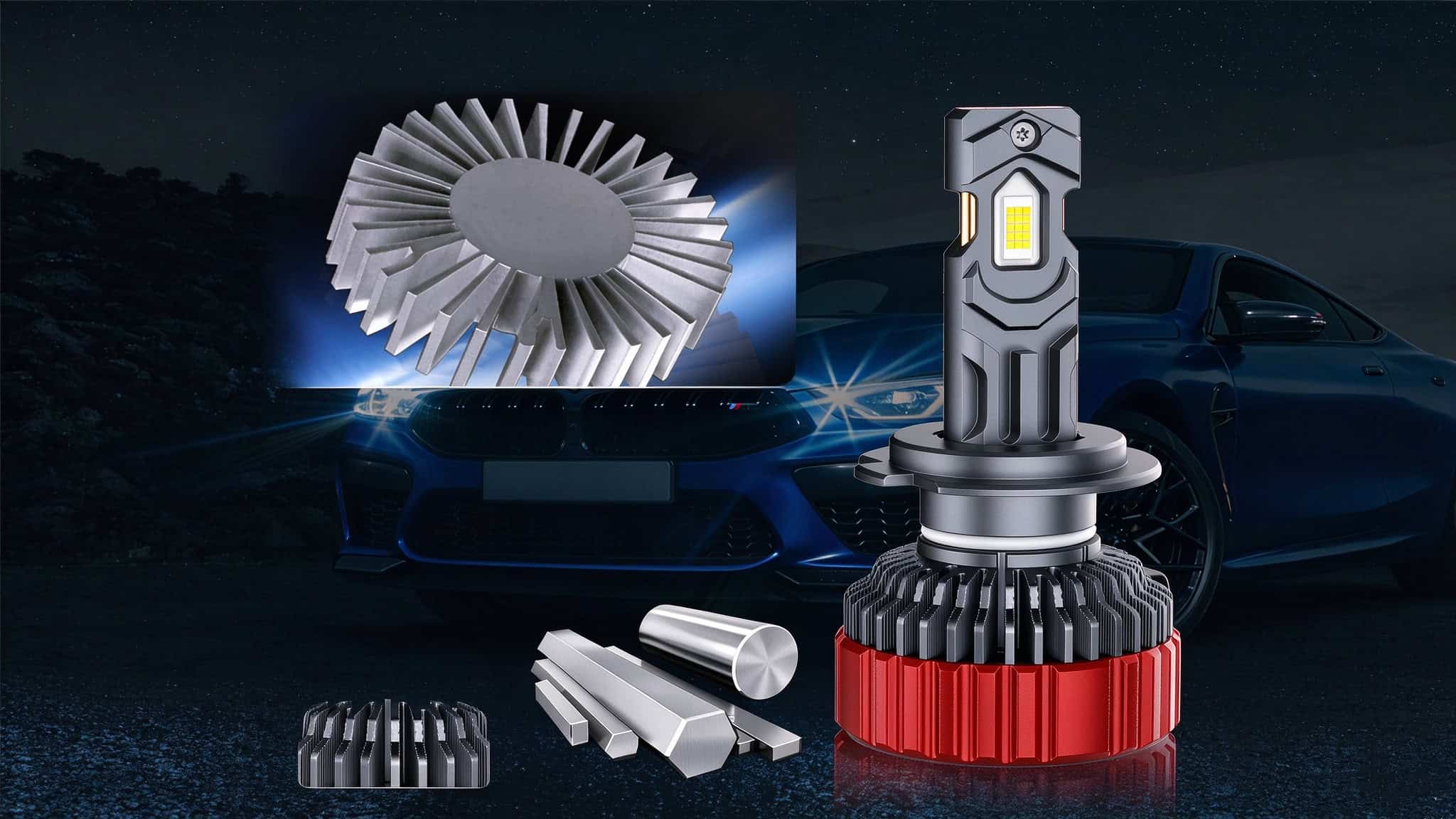
When sourcing aftermarket automotive LED headlights, most buyers first compare lumen output, color temperature, and bulb fitment. Yet the biggest difference between a 50,000-hour reliable bulb and a unit that fails within 6 months is never listed on the spec sheet — it’s the LED headlight manufacturing process behind the product.
Every production stage, from micron-precise chip placement to rigorous environmental and compliance testing, directly defines real-world durability, optical performance, and eligibility for global automotive standards. If you’ve ever wondered how automotive LED bulbs are made, and how to distinguish a quality factory from a low-cost assembler, this end-to-end breakdown walks you through every critical step.
SMT Production: The Electronic Foundation of Every LED Headlight
Surface Mount Technology (SMT) assembly is the first and most foundational stage of LED headlight production. This process mounts all electronic components onto the printed circuit board, and its precision directly determines long-term electrical stability, thermal dissipation efficiency, and even beam pattern accuracy. A chip misalignment of just 0.1mm can distort the cutoff line and create glare for oncoming traffic — a safety risk that fails most regional road regulations.
Key steps in SMT production for LED headlights:
- Solder paste printing: A precision steel stencil applies evenly measured solder paste across the aluminum-core PCB, a material purpose-built for high-power LED heat conduction.
- Automated component placement: High-speed SMT mount machines place LED chips, driver ICs, MOSFETs, and passive components with ±0.05mm positional accuracy. For dual-beam bulbs such as H4 and 9007, chip positions are calibrated to match the exact filament geometry of original halogen bulbs.
- Reflow soldering: Assembled PCBs pass through a multi-zone reflow oven with a strictly controlled thermal profile. This melts solder to form durable electrical and thermal bonds rated for -40°C to +85°C engine bay operating conditions.
- 100% AOI inspection: Every board goes through Automated Optical Inspection to verify solder joint integrity, component placement, and polarity before moving to final assembly.
Industry note: LED headlights built with manual soldering or low-precision SMT lines have 3-5
times higher failure rates from cold solder joints, flicker, and thermal runaway.
Mechanical & Optical Assembly: Building the Complete Light Engine
After the PCB is fully populated and tested, production moves to mechanical assembly — the stage where electronics, thermal hardware, and optical structures are integrated into a complete bulb. This step is often the most overlooked yet most critical determinant of real-world lifespan and beam quality. Many low-cost factories skip precision tooling and thermal interface control, resulting in bulbs that overheat or produce misaligned beams. watch our Youtube video:
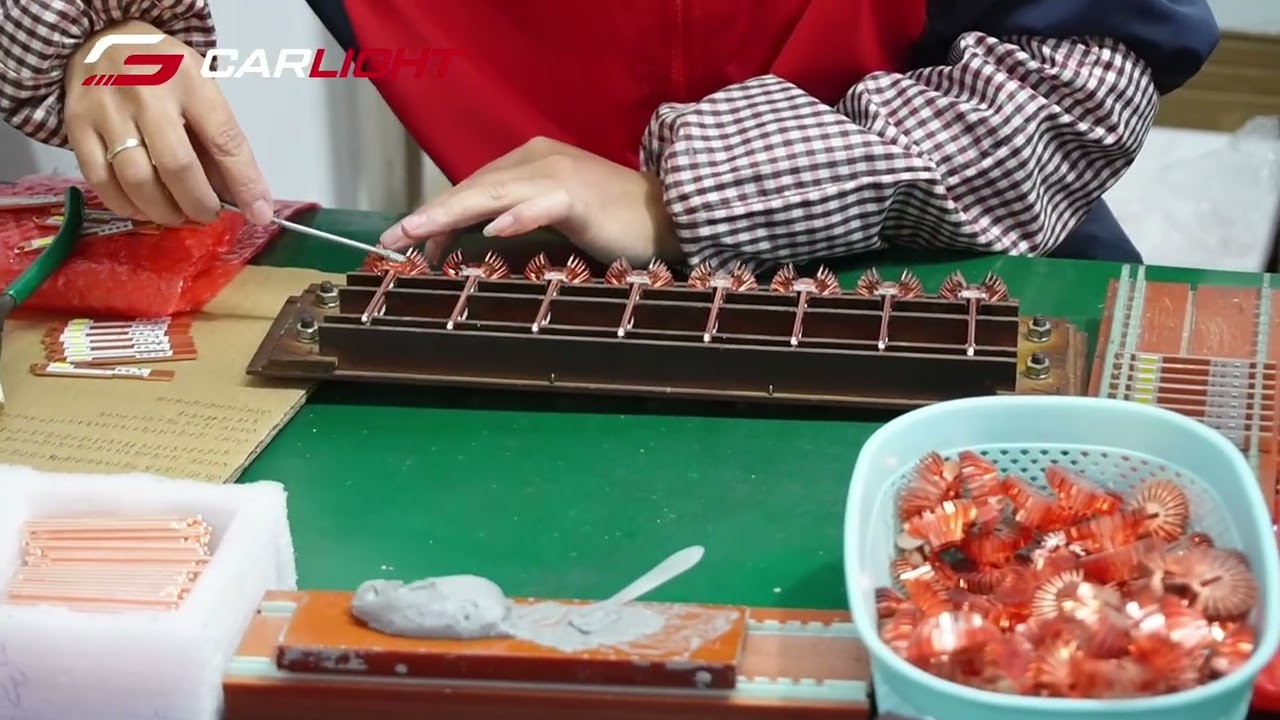
Heat Sink & Thermal Interface Assembly
Thermal performance is the single biggest factor in LED lifespan. Proper heat dissipation keeps chip junction temperatures within safe limits and prevents premature lumen depreciation.
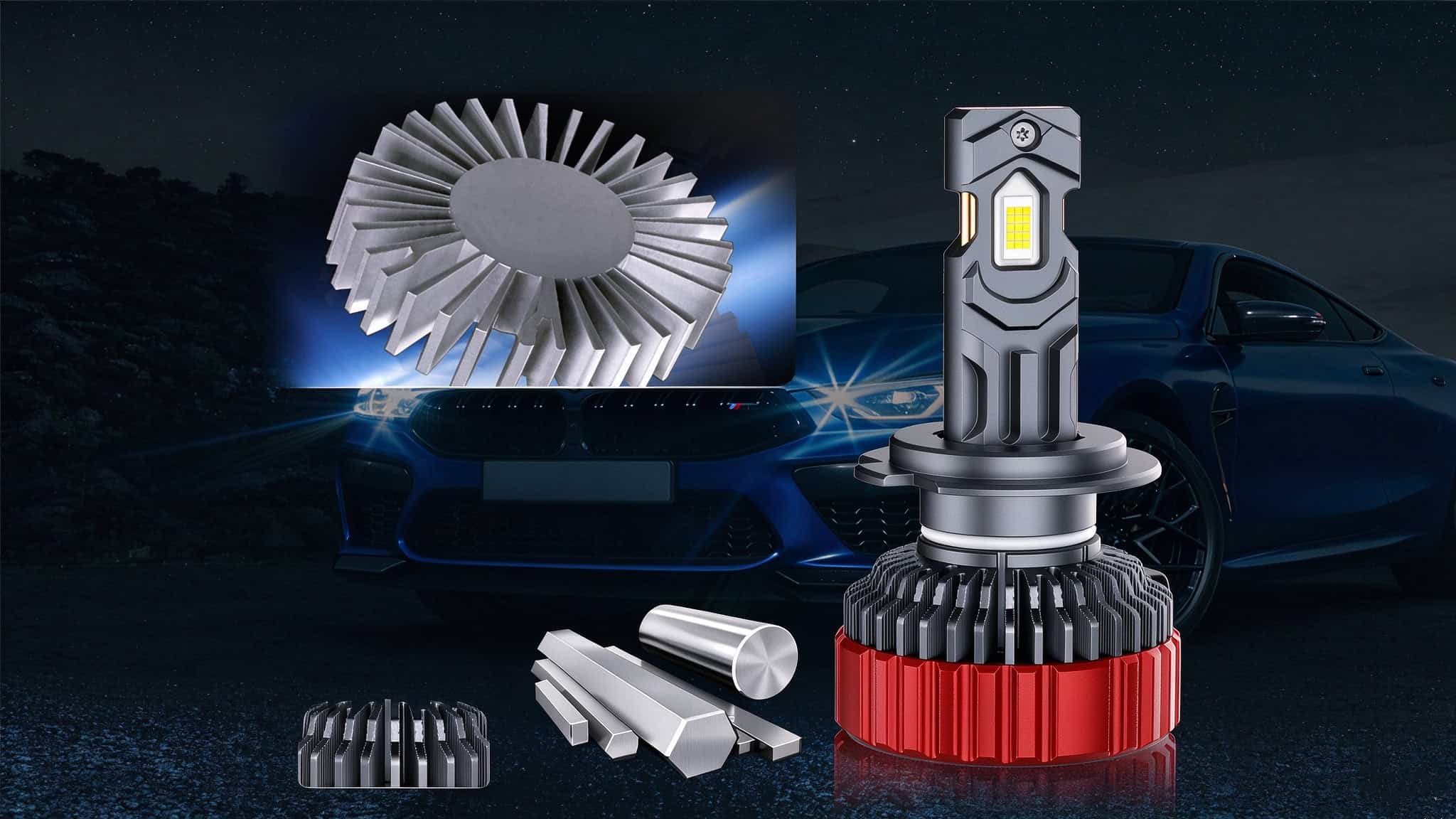
- Aluminum heat sink installation: The machined aluminum or copper heat sink is secured to the back of the LED PCB. High-performance models use copper heat pipes embedded into the fin structure for faster heat transfer.
- Thermal interface material (TIM) application: A precision-dosed layer of thermally conductive paste or pad is applied between the PCB and heat sink to fill microscopic gaps and maximize heat transfer. Automated dispensing ensures consistent thickness — too much or too little TIM both reduce cooling efficiency.
- Press-fit or screw fastening: The PCB is secured with controlled torque to ensure uniform pressure across the thermal interface without warping the board.
Driver Integration, Potting & Sealing
The LED driver is the brain of the bulb, and its protection directly determines reliability in harsh under-hood environments.
- Driver board connection: The SMT-built driver PCB is wired to the light engine with high-temperature silicone leads. Crimped or soldered connections are made to withstand constant vibration.
- Epoxy potting: The driver chamber is filled with thermally conductive epoxy resin. This seals electronics from moisture and vibration, and also conducts heat away from driver components.
- Housing seal assembly: O-rings or silicone gaskets are installed at all housing seams. For premium IP68-rated models, ultrasonic welding or threaded sealing with thread locker is used for permanent water resistance.
Fan, Base & Retainer Installation
Cooling and physical fitment are finalized in this sub-stage.
- Cooling fan mounting: The axial cooling fan is mounted to the rear of the heat sink and connected to the driver circuit. Fan speed calibration ensures sufficient airflow at rated wattage while keeping noise below acceptable levels.
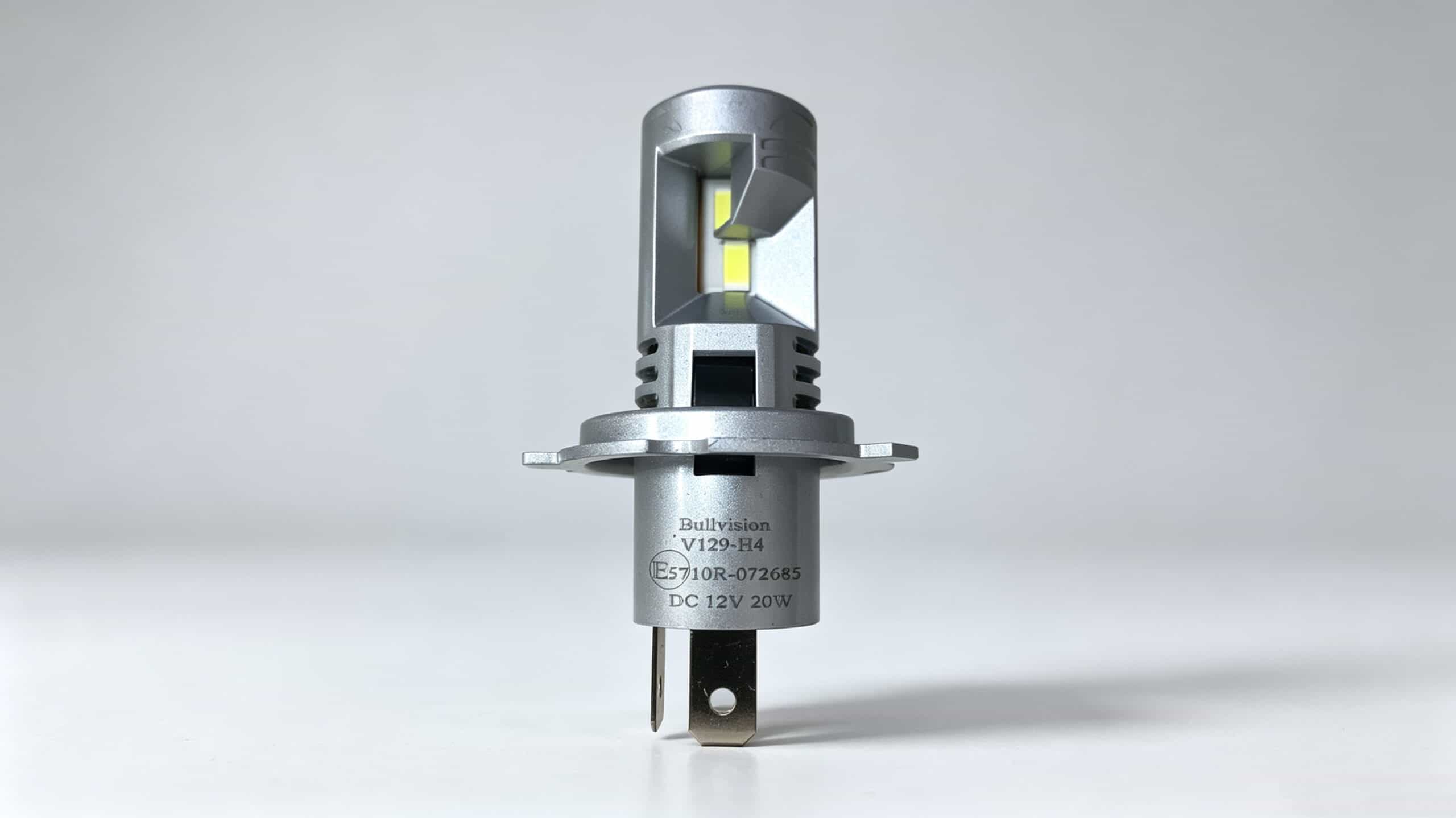
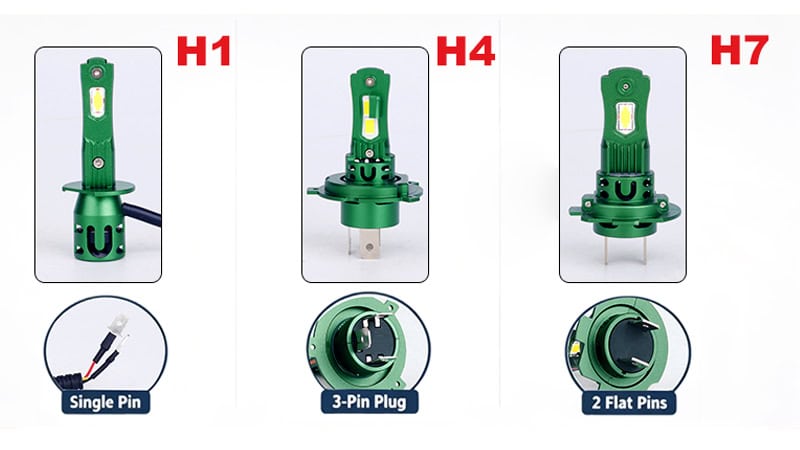
- Base and locking ring assembly: The bulb base (P14.5s for H7, P43t for H4, etc.) is attached to the main housing. The locking ring or spring clip is installed and checked for proper dimensional fit against OEM headlamp socket specifications.
- Connector termination: The vehicle-side power connector (usually AMP or Deutsch style) is crimped and sealed to the input wiring harness.
Optical Alignment & Photometric Verification
This step ensures the bulb produces a legal, glare-free beam pattern.
- Light source position calibration: The LED chip emission point is verified against the original halogen filament position using precision measuring fixtures. Deviations greater than ±0.1mm are rejected to prevent beam shift.
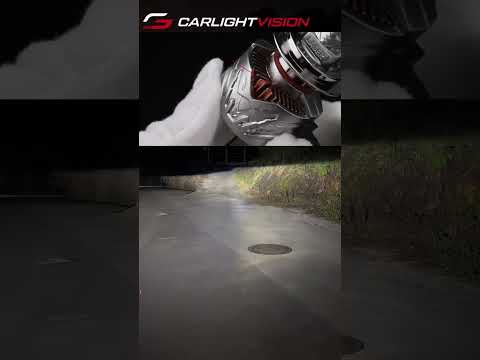
- Beam pattern spot check: Sample units from each batch are tested in a dark room goniophotometer to verify cutoff line sharpness, hotspot intensity, and glare values. This confirms the bulb will not blind oncoming drivers when installed in a standard headlamp housing.
- Quality checkpoint: Factories that skip optical alignment testing produce bulbs that may fit in the socket but produce scattered, illegal beam patterns. watch our Youtube video:
Aging Test: Burn In Early Failures Before They Reach Customers
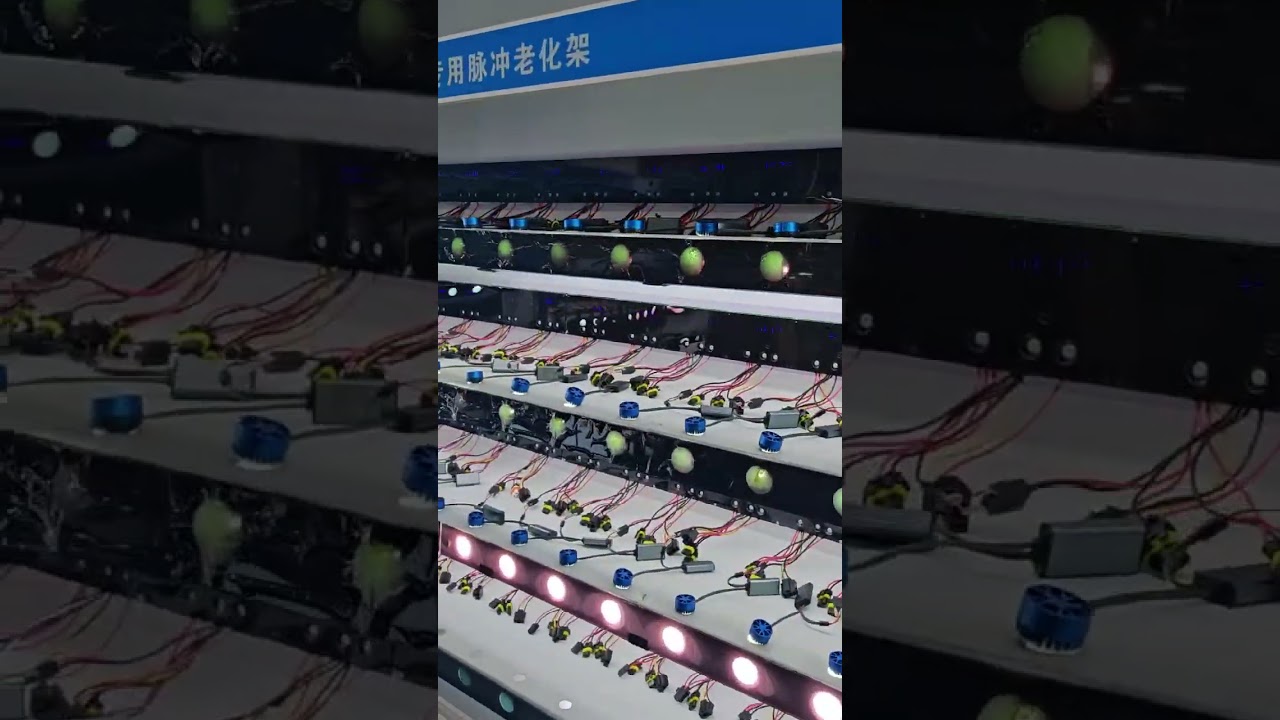
After the light engine is fully assembled, every unit undergoes a full-load aging test — the single most critical step for weeding out latent component defects.
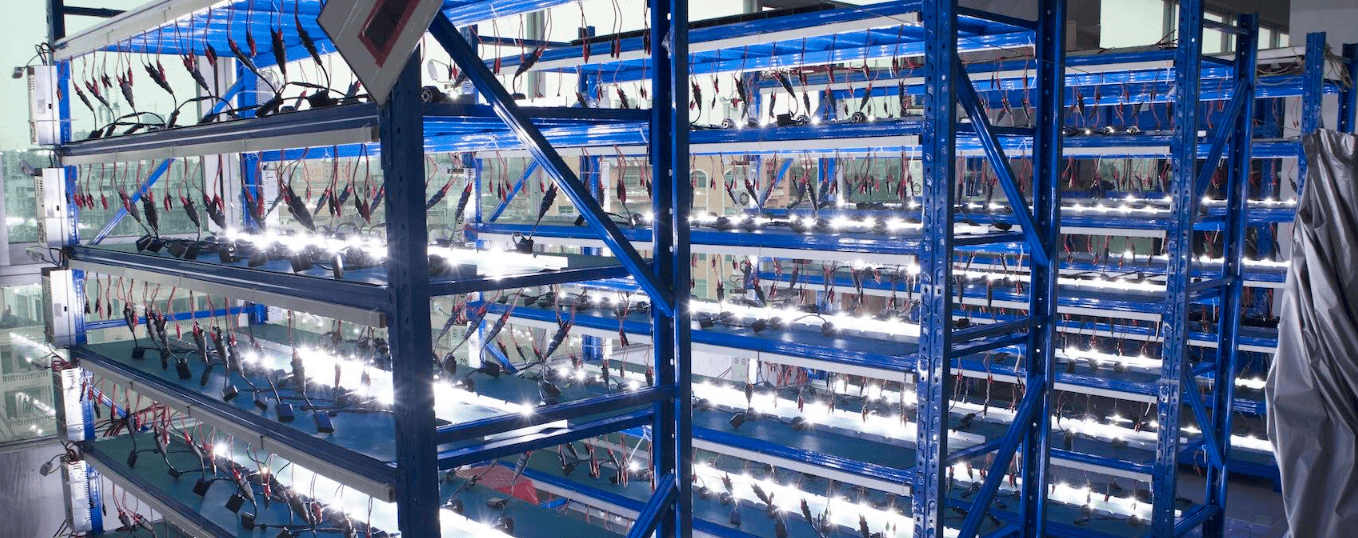
How aging testing works:
Each bulb is secured to a dedicated test rack and powered at its maximum rated wattage for a minimum of 8 consecutive hours. Throughout the cycle, automated monitoring systems track:
- Lumen output stability (no unexpected brightness drop)
- Color temperature consistency (no drift from the 6000K / 4300K specification)
- Cooling fan speed and noise level
- Driver housing temperature and input current stability
- Flicker, intermittent connection, or electrical faults
The principle is straightforward: by accelerating the “burn-in” period in a controlled factory environment, any defective chips, faulty drivers, or weak solder joints will fail on the test rack, not in a customer’s vehicle. Reputable LED headlight manufacturers run this test on 100% of production, not just random samples. Watch our Youtube Video:
Waterproof Test: Withstanding Rain, Snow, and Car Washes
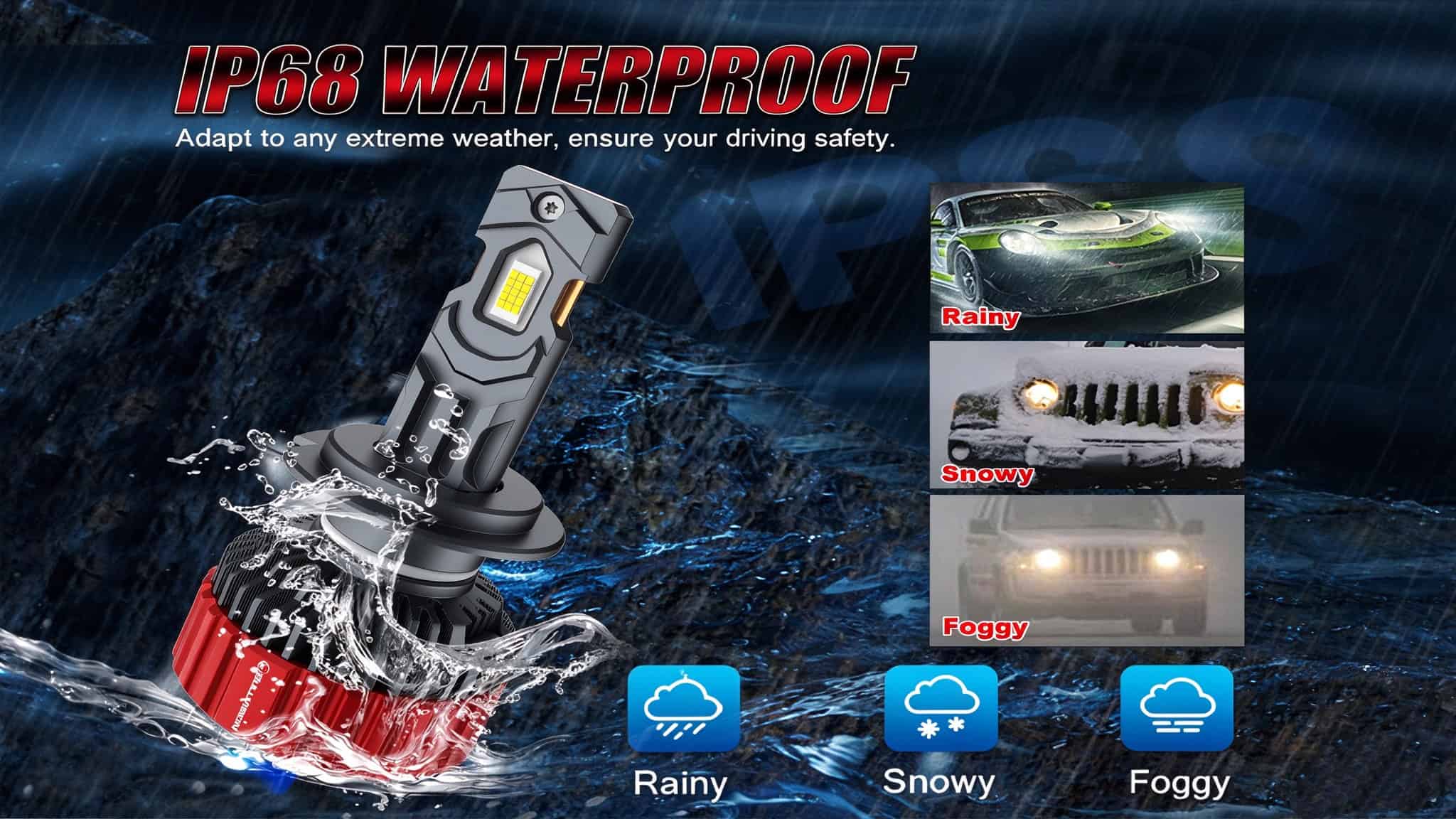
Vehicle headlights operate in harsh outdoor environments — heavy rain, snow, road spray, and high-pressure car washes. Waterproof testing verifies that internal electronics remain fully protected against moisture intrusion over years of service.
Standard waterproof testing procedures:
- IP67 submersion test: Fully assembled bulbs are submerged 1 meter underwater for 30–120 minutes, then immediately tested for electrical function and internal water intrusion.
- IP69K high-pressure spray test: Heated 80°C water jets are sprayed at all seal seams from multiple angles, simulating heavy-duty commercial vehicle wash cycles.
- Thermal shock water cycle: Hot bulbs at peak operating temperature are plunged into cold water to confirm internal pressure changes do not pull moisture through housing seals.
Genuine long-term waterproofing relies on more than a rubber gasket. Premium bulbs use epoxy potting inside the driver compartment and precision-machined housing threads to achieve sustained IP68 / IP69K ratings.
EMC Test: Meeting Global Automotive Electromagnetic Standards
Electromagnetic Compatibility (EMC) testing is a mandatory requirement for road-legal automotive lighting worldwide. Poor EMC design can cause radio static, dashboard warning lights, CANbus system interference, and even disrupt critical vehicle electronics.
Core EMC test items for LED headlights:
- Conducted emission test: Measures electrical noise fed back into the vehicle’s power supply wiring
- Radiated emission test: Verifies the bulb does not emit radio frequency interference that affects onboard electronics
- Electrostatic discharge (ESD) immunity: Confirms the bulb survives static electricity discharges common in dry environments
- CANbus compatibility verification: Validates flicker-free operation and no dashboard error codes on European, North American, and Asian vehicle CANbus architectures
Products certified to ECE R10, FCC Part 15, and CISPR 25 standards are legally roadworthy and free of common side effects on modern vehicles. Many low-cost unbranded bulbs skip full EMC certification entirely.
Packing Process: Protection for Global Shipping
Even a perfectly built bulb can arrive damaged if packaging is treated as an afterthought. Professional packing is engineered to survive long-distance ocean freight, extreme temperature swings, and rough logistics handling.
Standard packing workflow:
- Final visual & function QC: Inspection for surface scratches, label accuracy, and one final lighting function test
- ESD anti-static bagging: Each bulb is sealed in an electrostatic discharge bag to protect sensitive driver electronics
- Shock-absorbent inner packaging: Custom foam or blister trays secure bulbs in place and absorb impact during transit
- Outer carton sealing: Printed cartons marked with batch codes, barcodes, and international handling labels
- Palletization: Cartons are strapped and shrink-wrapped onto standard pallets for container loading
Every carton carries a unique traceable batch number, so any quality concern can be traced back to the exact production date, test records, and raw material lot.
Warehouse Management: Controlled Storage & Full Batch Traceability
The manufacturing process does not end when production is complete. Proper warehouse management preserves product quality and ensures fast, accurate order fulfillment for global clients.
Warehouse management standards for LED lighting products:
- Climate-controlled storage: Temperature and humidity are regulated to prevent moisture damage to electronic components and optical lenses
- First-In-First-Out (FIFO) system: Older production stock is shipped first to avoid performance degradation from extended storage
- Batch segregation: Different bulb models, wattages, and production batches are clearly separated to prevent order fulfillment errors
- Pre-shipment spot check: Random sampling inspection before dispatch to confirm order accuracy and packaging integrity
For OEM/ODM partners, most professional factories also offer consignment inventory and private label warehousing services.
Final Thoughts: Manufacturing Process Defines Real-World Quality
The LED headlight manufacturing process is where marketing claims become proven performance. A bulb that goes through fully automated SMT, 8-hour 100% aging testing, IP67 submersion verification, and full EMC certification will always outperform a low-cost alternative built with skipped steps and sample-only testing.
If you are sourcing LED headlights for your brand, retail business, or workshop, always ask for production and testing protocol details — not just the specifications on a datasheet. A factory that can share complete batch test records is a partner you can trust for long-term quality.
FAQs
Q1: How long does the full LED headlight manufacturing process take?
For standard production runs, the complete cycle from SMT assembly to warehouse-ready stock takes 7–10 business days. Rush orders can be completed in 3–5 days with priority production scheduling.
Q2: Do all LED headlight manufacturers perform 100% testing?
No. Many low-cost factories only test 5–10% of production on a sampling basis. This is why budget LED bulbs have significantly higher field failure rates.
Q3: What certifications are required for selling automotive LED headlights?
Core global requirements include EMC certification (ECE R10 for Europe, FCC for the US), IP waterproof ratings, and photometric compliance for beam patterns. Requirements vary by country and region.
Q4: Can I customize the manufacturing process for my own brand?
Yes. OEM/ODM clients can add custom testing procedures such as salt spray testing, vibration testing, or extended aging cycles, as well as custom PCB design, housing modifications, and private label packaging.
Partner With a Top-Tier LED Headlight OEM/ODM Manufacturer
Looking for a reliable automotive lighting factory that builds quality into every production step, not just marketing copy? Our engineering team, with over 20 years of industry experience, is ready to support your LED headlight project from prototype to mass production.
What we deliver for global B2B partners:
- Full process transparency: Access complete SMT, aging, and QA test records for every production batch
- Flexible customization: Tailored PCB design, custom housing tooling, and full private label packaging solutions
- Certified compliance: All products engineered to meet ECE R10, FCC, CE, and IP68/IP69K global standards
- Stable supply chain: In-house SMT, molding, and testing lines for consistent lead times and quality control
Request a Free Sample & Virtual Factory Tour
Or email our engineering team directly at carlightvision@gmail.com for a technical consultation and custom quote within 12 business hours
Written by Mark Yang | 25 Years in Automotive Lighting Quality & Sourcing