Selecting an inappropriate headlight bulb is not only costly in financial terms but also in terms of beam pattern, road visibility, and, in certain instances, the safety of other road users.
Two of the most used headlights in the world are the H4 vs H7 bulbs, which are not interchangeable, are constructed differently, and operate differently. Let’s explore precisely what makes them different and which one your car or vehicle fits.
What are the H4 and H7 car light bulbs?
H4 and H7 are both halogen headlights with the international ECE standards, and they are the default headlights in European and Asian automobiles. Although they are similar to each other at first sight, their internal composition and use are quite different when comparing the difference between h4 and h7 bulbs.
1. H4 Bulb Overview
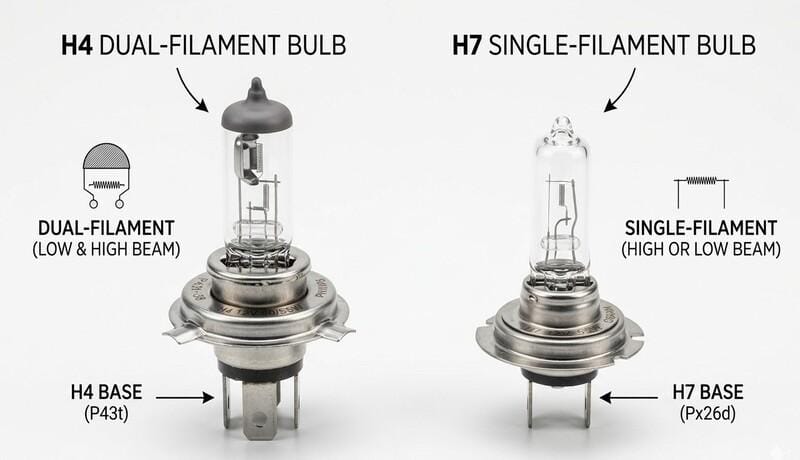
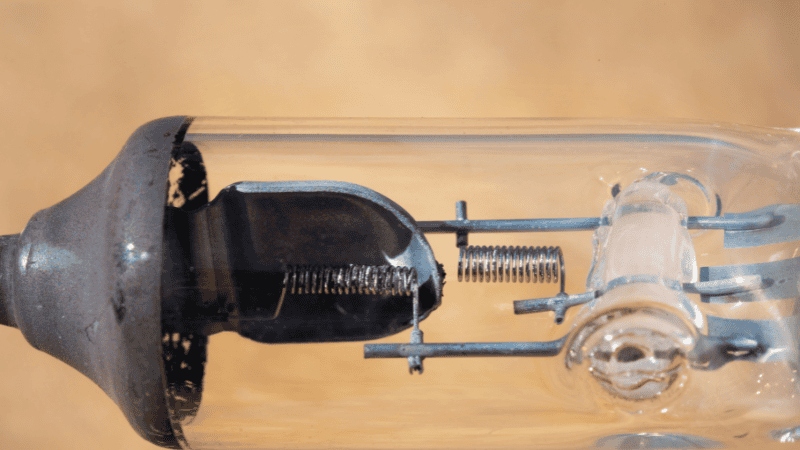
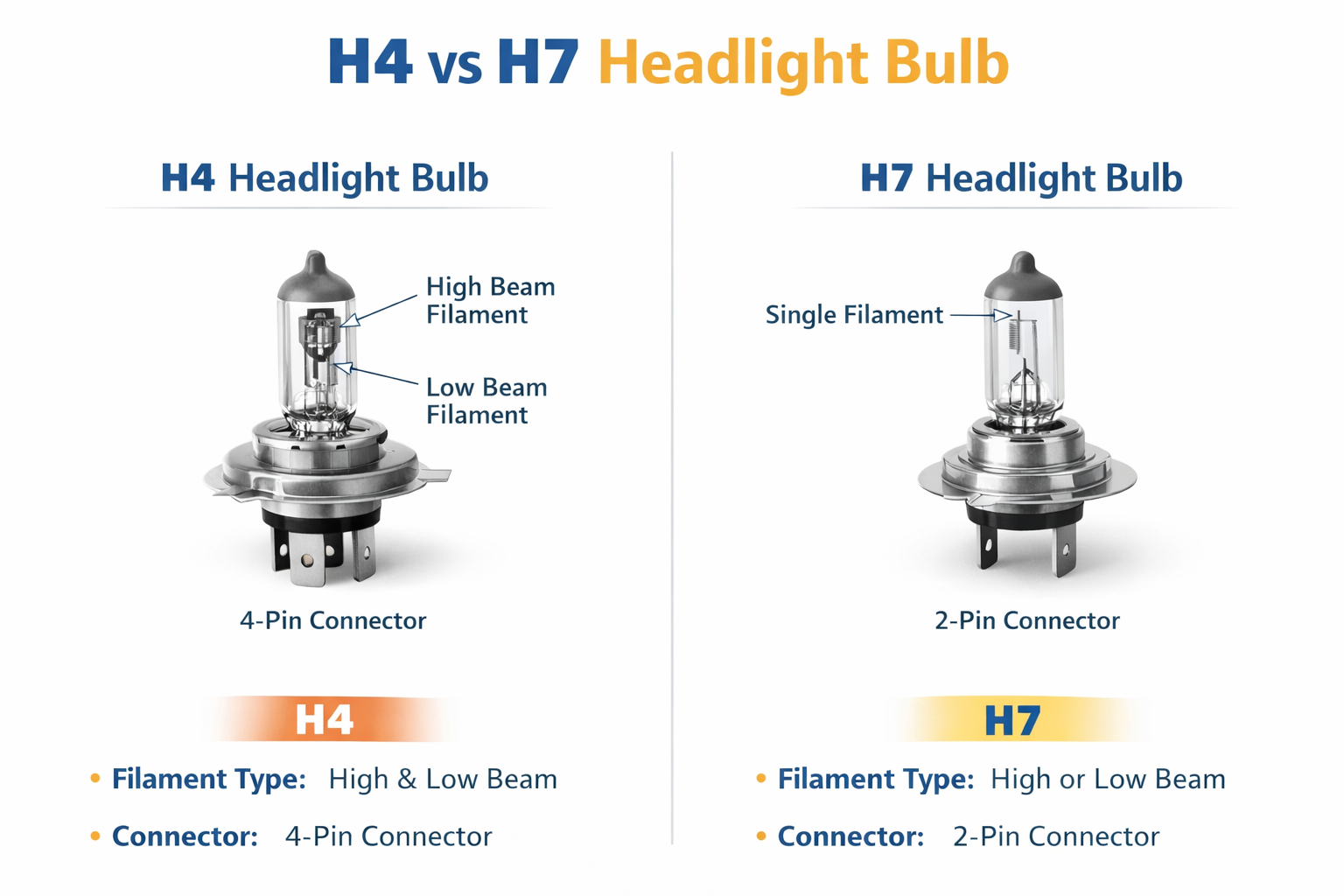
H4 bulb or HB2, also known as 9003, is a dual-filament bulb. It has two filaments within one glass envelope, one of which is a low beam and the other a high beam. This implies that only an H4 bulb is required to serve the two purposes of light, and hence it has been widely used in the simple headlight assembly of simpler and smaller schemes. To fit both of the circuit types in filament, the connector is a three-pin one.
2. H7 Bulb Overview
The H7 is a single-filament bulb. It emits a single beam (either high or low) and thus would need two bulbs per headlight, one low beam and one high beam. The connector is a two-pin connector. H7 bulbs are made in more complex headlight housings where optical accuracy takes precedence over simplicity.
3. Why These Bulbs Are Common in Vehicles
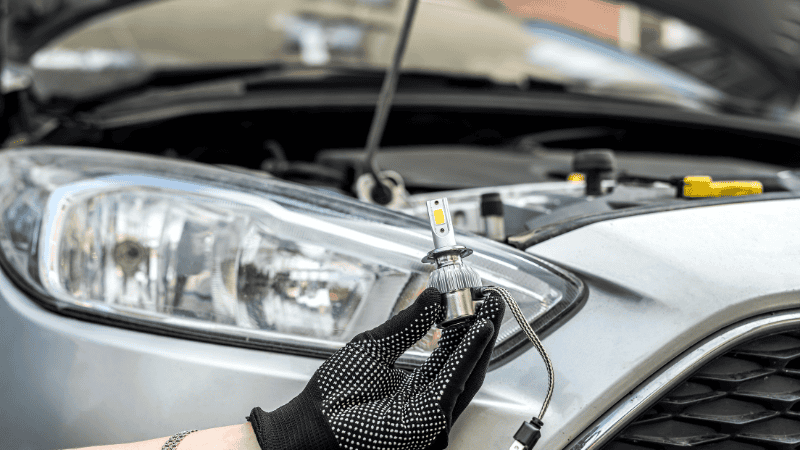
H4 and H7 headlight bulbs rule the market since they belong to the ECE R37 international bulb standard, which regulates the lighting on vehicles in Europe and Asia, and the larger part of the world, not found in North America.
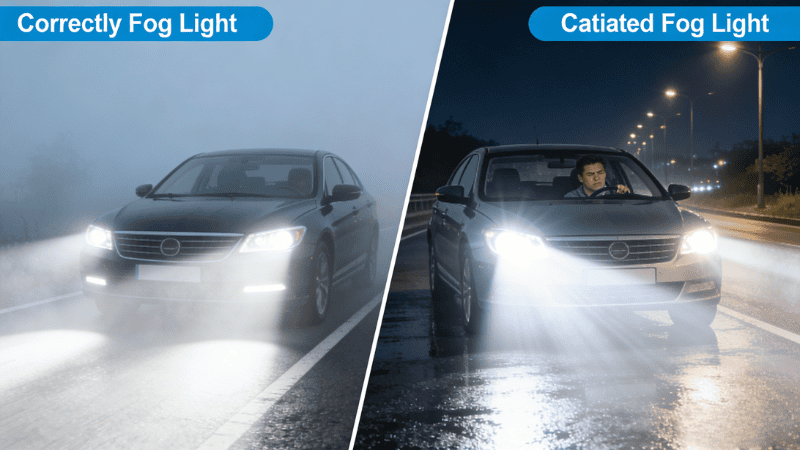
Dozens of countries worldwide use these two bulbs in their headlight systems, following this standard, which minimizes discontinuity and thus enables consistent specifications and compatibility across these two bulbs. These headlights often complement fog lights to enhance visibility in rain, fog, and low-contrast conditions.
H4 finds use in the automotive sector in budget applications as well as in motorcycle applications, whilst H7 is used in the high-end European cars where beam accuracy and individual optics are included in the design requirements.
What’s the difference between H4 and H7 bulbs?
There is no universal better or worse bulb, as it all depends on your vehicle’s system of headlights. Below is their comparison of H4 vs H7 bulbs, the aspects that count.
Lighting and Filament Capability
The H4 headlight bulb has two filaments in a single bulb, which is capable of doing both the low and the high beam. The H7 has a single filament and can only operate one beam. This simplifies and reduces the cost of servicing H4, which has only one bulb to replace, which serves the two beams.
Systems are of H7 design, which utilizes two bulbs on each side, but the filament can be adjusted to its respective beam application, and this can form a more focused output.
Design of Headlights and Beam Pattern
H4 headlight bulbs operate in either a single reflector or projector housing, which switches between beams by turning on other filaments. H7 lamps are fitted together into dual optic casings, one reflector or projector in low beam, another in high beam.
The H7-based design offers more control over beam shaping than what is possible with the separate system, hence they are typical of projector-based lenses, headlights on mid-range to up-market cars.
Base Type and Installation
H4 headlight bulb is based on the P43t with a three-pin connector. The base of H7 has a two-pin connector PX26d. The physical underlying is totally different, with a locking tab, pin spacing, and a different socket shape. This is because no standard housing has an adapter that is safe for converting from one to the other.
Vehicle Compatibility
The older European vehicles, motorcycles, low-end hatchbacks, and most of the Asian market vehicles also use the lampu LED H4 bulbs. H7 is common in a great variety of modern European cars, such as a large number of BMW, Volkswagen, Audi, Mercedes-Benz, and Renault models.
| Feature | H4 | H7 |
|---|---|---|
| Also known as | 9003, HB2 | — |
| Filaments | Dual filament design(high + low) | Single |
| Base type | P43t (3-pin) | PX26d (2-pin) |
| Beam function | High + low in one bulb | One beam per bulb |
| Bulbs per headlight | 1 | 2 |
| Typical wattage | 60/55W | 55W |
| Common vehicles | Motorcycles, older EU/Asian cars | Modern European cars |
| Interchangeable | No | No |
How does an H4 lamp work?
During a low-beam switch-on, the electrical system of your vehicle chooses to pass the current to the low-beam filament of the H4 headlight bulb. To ensure the cutoff line is such that oncoming drivers are not subjected to glare, a metal shield is placed around that filament to shield against the projection of light.

Activate the high beam, and current flows to the second filament; this time, they are not enclosed in a shield, and they are in a different location in the bulb. The bulb envelope and base are the same in both filaments, and the three-pin connector is used to route the current to the appropriate filament depending upon which beam is being used.
How does an H7 lamp work?
The H7 bulb has a single filament that is located in the middle of the glass envelope. It gives only a single fixed output beam, low or high, as it is mounted in one housing or another. With low-beam housing, the reflector or projector optics form a flat, cutoff beam that is directed downwards so as to reflect the light onto the road without blinding oncoming traffic.
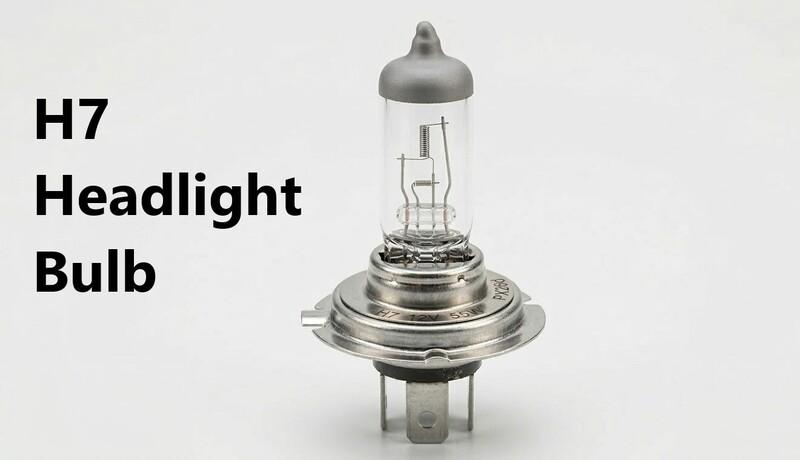
In a high-beam home, light is projected farther along the road without any cutoff. The single filament of the H7 makes the bulb smaller, and the optics can be cut along one beam operation with much higher precision.
Are H4 and H7 bulbs interchangeable?
No. Under normal conditions, the H4 and H7 headlight bulbs cannot be interchanged in each other’s sockets.
Why H4 and H7 Bulbs Are Not Compatible
Each bulb has a different base design: pin count differs, spacing differs, and locking mechanism differs. An H7 headlight bulb cannot be fitted in an H4 socket, and the opposite is true. On top of the incompatibility, the housing of the headlight is built with consideration of the different filament positioning of a given bulb.
The reflector geometry and focal point are determined for a dual-filament led h4 or for a single-filament H7 headlight bulb. Installing the incorrect type of bulb, even with an adapter, places the filament in the incorrect focal arrangement and destroys the desired beam pattern.
Risks of Using the Wrong Bulb Type
The wrong bulb or an incompatible adapter will present a number of issues. The beam pattern is erratic; instead of creating a cutoff, the light can be scattered, and this way, you see less of the road, in addition to throwing glare into oncoming traffic. A misaligned filament in the projector housings will lead to the beam being directed too high, thus posing a great danger on highways.
In addition to being unsafe, installing an unapproved bulb design can lead to a failed inspection of the vehicle, and in the case of a car crash where lighting is a factor, the coverage may be invalidated.
How To Install an H4/9003 LED Headlight Bulb?
Check your bulb type. To verify the type of bulbs used by your vehicle, check the owner’s manual or the imprint on the current bulb.
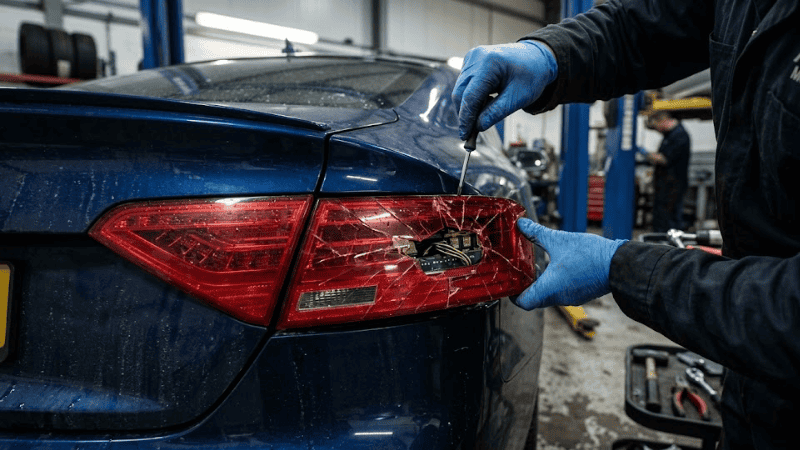
- Step 1: Turn off the car and allow the Headlights to cool off for at least 10 minutes. Halogen lamps retain a lot of heat.
- Step 2: Open the hood and find the rear of the headlight assembly. There are vehicles that demand the removal of a dust cover or an access panel.
- Step 3: Disassemble the connection wiring of the current bulb, extract the release tab on the connector, and pull away.
- Step 4: Replace the old bulb by twisting it counterclockwise (approximately a quarter turn) and pulling it out of the mount.
- Step 5: Choose the LED bulb and place it into the receptacle, ensuring the tabs fit into the slots in the receptacle. Turn clockwise to fix its size. Hold not the glass bulb in bare hands.
- Step 6: Check the wiring harness by connecting it to the new bulb. In case the LED kit comes with a CAN bus driver or ballast, install it away from heat sources with the provided hardware.
- Step 7: Turn on and off the low and high beams before reconnecting any of the covers. Make sure that the beam pattern is right and that the dashboard displays no warning lights.
- Step 8: Repeat on the other side. Headlight bulbs should always be changed together.
How To Install an H7 LED Headlight Bulb
H7 installation is identical to the previous one, with the addition of one important factor, that in most H7 LED bulb installations, a retention adapter is necessary since the LED base dimensions are slightly smaller than the halogen base.
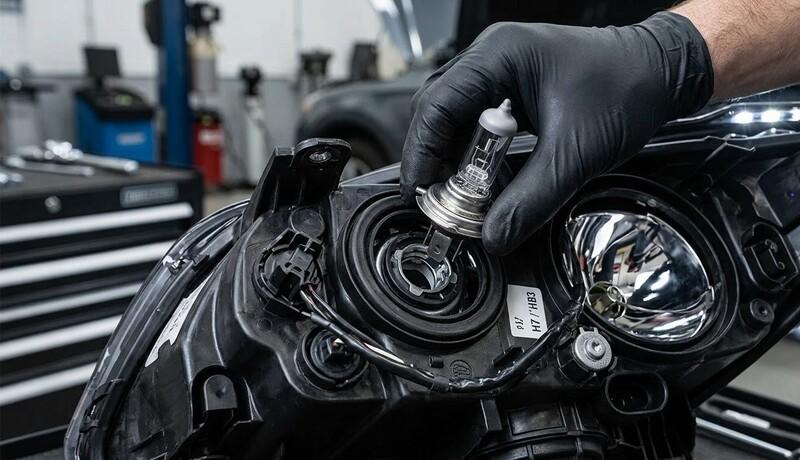
Step 1: Turn off the car and leave the old bulbs there until they cool down.
Step 2: Take out the dust cover on the back of the headlight. It is either twisted off or has a clip, depending on the car.
Step 3: Disconnect the wiring harness by pressing the connector tab and removing it.
Step 4: Press the spring or clip that secures the retaining bulb in place, then swing it out.
Step 5: Pull out the H7 headlight bulb straight without rotating it.
Step 6: Install the retention adapter (when provided with the LED kit) by inserting it into the socket of the housing. This helps to keep the LED at the right focal depth.
Step 7: Install the LED bulb in the adapter with the chips that produce light facing horizontally at 3 o’clock and 9 o’clock to project the beam properly.
Step 8: Remodule the harness and hook on any CAN bus decoder as needed.
Step 9: Check beam pattern: Have the headlights illuminated on the flat wall of a size of 3 meters. The line of cut-off must be sharp and level, not curved upwards on either side.
Step 10: Do the same thing on the other side and put the dust cover back in.
Can You Upgrade H4 or H7 to LED Bulbs?
Yes, both H4 and H7 may be changed to LED; however, there are three facts to check before buying a kit.
CANbus compatibility
CAN bus also allows modern vehicles to check the bulb resistance and wattage. LEDs consume much less energy compared with halogens, which the system detects as a non-functioning bulb. The majority of quality LED kits come with a CAN bus connector or an in-built decoder that replicates halogen resistance and is used to avoid spurious warning lights.
Headlight housing
LED upgrades are best used in projector housings that are meant to be optimally matched by a specific source of light. The LED chips may not emit the light in a predictable direction, and even cause glare in older reflector housings, which are typical of a car originally equipped with H4 bulbs.
There are reflector housings that do well with LEDs made to be used here, but this is not always the case. In case beam quality is important, one projector retrofit can also be considered in addition to the bulb upgrade.
Legal rules
LED bulb upgrades are in a grey area of most markets. The EU permits only ECE-recommended LED replacement bulbs for vehicles initially equipped with halogen headlights. More and more LED retrofit kits are now ECE R37 approved, yet many available in the market are not.
Regulations became stricter after the UK left the EU, but they are generally based on the same idea. In the US, DOT compliance applies. Always ensure that the kit you are buying has approval for your country of residence before installing it in a road-going car.
Conclusion
The purpose of H4 and H7 bulbs is the same: to provide a lighting solution on the road ahead. They are designed and manufactured to fit different headlight systems. Being fully aware of what type of bulb your car uses, the complexities of its operation, and the proper and improper methods for changing or updating this bulb is the difference between a well-lit, safe road and a grave danger to yourself and other cars.
Get the Right Bulb the First Time With Carlikevision!
At Carlikevision, we offer H4, H7, and LED upgrade kits that are built to meet ECE and DOT standards, so you can be confident in compatibility and avoid substandard parts. You can replace one burned-out bulb or upgrade an entire fleet to LED.
Our catalog includes all major vehicle manufacturers with confirmed fitment information. Find what browse Carlikevision offers for headlight bulbs, or ask our team about fleet and wholesale rates.